.png)
 Andrew Utterback
BY ANDREW UTTERBACK
Podcast Producer
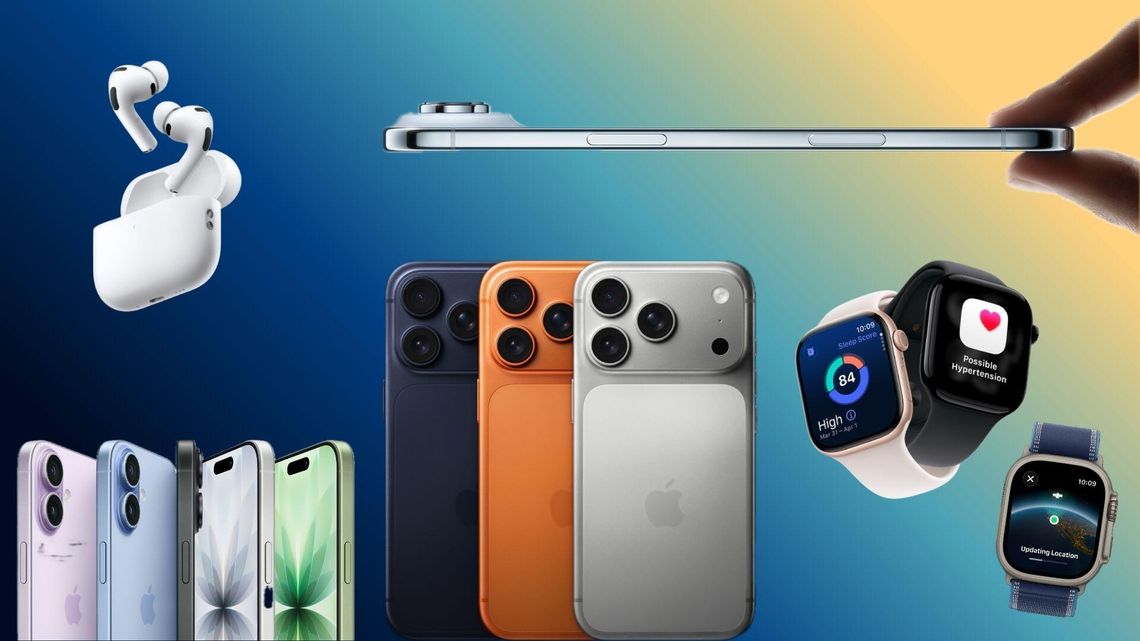
Apple unveiled the first ever iPhone Air at their annual iPhone-focused September event, alongside the iPhone 17 and 17 Pros, Apple Watch Series 11 and Ultra 3 and AirPods Pro 3. This year’s phones received what looks to be quite a promising upgrade, while the watches and AirPods received less flashy improvements. Let’s start with the most exciting of the day.
iPhone Air
The iPhone Air is here… and wow, is it thin. Coming in at 5.6 mm thin, (the standard iPhone 17 is 7.95 mm), it’s now the slimmest iPhone ever made. We get a full titanium design with Apple’s Ceramic Shield now on the back of the phone, as well as Ceramic Shield 2 on the front. This second version of Apple’s screen coating, that they say is “bonded to Ceramic Shield at the atomic level,” provides up to three times better scratch resistance, and when paired with the titanium design, makes the Air “more durable than any previous iPhone.” That freshly coated display is a great one as well: A 6.5 inch 120hz Super Retina XDR display with now up to 3000 nits of peak brightness. Inside the Air we get the new A19 Pro chip, Apple’s C1x cellular modem and the brand-new N1 chip for Wifi 7, Bluetooth 6 and Thread connectivity. The Air is the only iPhone in the new lineup to feature the C1x modem, while the 17 and 17 Pros still use Qualcomm’s.
Apple achieves the thinness on the Air by packing almost all of the internals of the phone into the “camera plateau,” a rectangle, Google Pixel-esque camera bar that spans the whole width of the top of the phone. You get one camera on the Air, a 48mp Fusion main camera that allows for a 2x optical crop. Apple claims you get “the equivalent of four lenses” with this one Fusion camera, and on the front of the Air, we get one of my favorite features of the whole keynote. The selfie camera on all of the new iPhones this year is now an 18mp Center Stage camera. Center Stage comes from the iPads and Mac lineups and is essentially an ultra-wide selfie camera that crops in on you, the subject. This allows it to “track” you if you move around the frame by changing where it crops. This new sensor is also square, which means you can take landscape selfies with the press of a button and don’t actually have to rotate your phone. Apple says the new iPhones will know when multiple people walk into the frame and will automatically switch to landscape. You can also take stabilized video from the selfie camera, similar to Action Mode on the rear cameras.
Apple claims the iPhone Air gets “all day battery life” and 27 hours of video playback. That playback estimate is the same as last year’s 16 Pro, which means the Air should have a decent enough battery. Battery life is greatly aided by the camera plateau, which allows the battery to take up far more internal space.
My first thoughts after hearing about the slimmest iPhone yet were: “This is going to have horrible battery life,” “The specs are sure going to suffer” and “There’s no way this passes any sort of durability test.” Surprisingly, every one of these “thin phone” concerns seems to be addressed by Apple in some way. The specs are more than solid, and Apple’s decision to stay with titanium while the rest of the lineup goes back to aluminum seems like a decision made purely for durability. Aluminium is cheaper, lighter and conducts heat better than titanium, but is ultimately not as durable. This is a phone that ideally shouldn't meet the same fate as the iPhone 6 after launch, but we’ll have to wait for the JerryRigEverything bend test.
The biggest red flag for me is that Apple is offering a $99 MagSafe battery pack that only fits the iPhone Air. They quote (with the battery pack) up to 40 hours of video playback, one more hour than the 17 Pro Max and 13 extra hours than the Air without the battery pack. I think Apple saying that the Air has “all-day battery life” and then offering a battery bank custom made for it is concerning, but we’ll see.
The question for me is, why does this phone exist? The base iPhone 17 gets every single feature I just mentioned, minus the C1x modem and Pro chip, and adds an extra ultra-wide camera, better battery life, faster charging and is $200 cheaper. The selling point of the Air is entirely its design (and slightly faster chip). I have yet to see it in person, but we’ll have to see if the thinness is enough to push people to spend the extra money. I think it could be, given how much average consumers love noticeable visual changes to iPhones, and I definitely think physically holding the Air is what will sell most potential buyers.
But I think the iPhone Air isn’t, by itself, Apple’s future vision for the iPhone. Rumors are pointing to Apple launching the long-awaited folding iPhone as soon as next year, and to achieve a folding phone form factor that doesn't feel like a brick in your pocket, they would need to make both halves of the phone very thin. Likely around 5.6mm thin if you get where I’m going. I think the iPhone Air we’re seeing now is half of the folding iPhone we’re going to see in the next year or so. The Air even comes with only one speaker grille at the bottom, a strange move given all the saved space in the main part of the phone, but one that could make sense if it was working in tandem with another speaker on the other “half” of the phone. This may be the best look we get at Apple’s vision for a folding iPhone, and if this is the case, we should be in for a treat.
All of this year’s new iPhones also get 256GB of storage as the base. The iPhone Air comes in black, gold, white and blue and will start at $999.
iPhone 17
Ladies and gentlemen, ProMotion. The base iPhone 17 now has a 120hz display. The biggest knock on the base iPhones for at least the past two or three years is finally no more.
Apple could have added only that to the new base model iPhone and I would have been thrilled, but the 17 sees, as I mentioned, essentially every headlining feature of the Air. The 17 is powered by the A19 chip, a slight step down from the Air’s A19 Pro and has a 6.3-inch version of the same display. It gets Ceramic Shield 2, (on just the front) and adds a 48mp Fusion ultra-wide to pair with the 48mp Fusion main camera.
This year, the base iPhone, thanks to ProMotion, will feel exactly like the Pro when used side by side. That right there is enough, I think, to keep a lot of "average" buyers from getting the Pros if they’re on the fence. This should be an excellent phone for $799.
iPhone 17 Pro
This year’s Pro iPhones feel a bit different. It seems like now with the 120hz equipped 17 and the $1000 Air, the Pros had to differentiate themselves a bit more than usual, which I think they did to an extent. The 17 Pro and Pro Max get every feature I’ve mentioned and pack them into the first “new” design we’ve gotten in quite a while.
The 17 Pro now uses an aluminum frame, instead of titanium like in the past two Pro iPhones, as well as the new Air. Apple says the aluminum frame can dissipate heat 20 times better than titanium, which paired with the new vapor cooling chamber that pulls heat away from the A19 Pro chip, allows for 40% better sustained performance than last year’s 16 Pro. This gives the 17 Pro the “best-ever” thermal performance in an iPhone.
The Pro’s new two-tone unibody design does actually look different from the past several Pros and features a much larger version of the “camera plateau.” The now massive, although also now uniform camera bump, allows for a much larger battery, which according to Apple, provides 39 hours of video playback on the 17 Pro Max. That’s a six hour increase from the 16 Pro Max (A bigger battery life jump than usual).
Camera-wise, we once again get three, but now all cameras are 48MP. The Fusion main, Fusion ultra-wide and Fusion telephoto fill up the 17 Pro’s camera plateau. It’s a big year for Fusion. The telephoto camera is the only one to see an upgrade, offering 4x optical zoom and up to 40x digital. This is technically less optical zoom than the 16 Pro, but thanks to the telephoto camera now having a 48MP sensor, the “Fusion” allows for an 8x optical crop, producing a 24MP photo. All that Fusion just means the 17 Pro has what Apple (for some reason) likes to call the “equivalent of eight lenses” by cropping in on the large sensors to allow for different preset focal lengths. On the front, the Pros also get the new Center Stage selfie camera.
The Pros get Ceramic Shield 2-coated, 6.3- and 6.9-inch displays on the Pro and Pro Max respectively. These displays have all the same specs as the rest of the 17 series, including the new anti-reflective coating.
So, the main Pro features this year are the new design with better cooling and battery life and the 48MP across the board camera set. It’s the traditional “performance, camera and battery life” year-over-year improvements, but a little more than usual. I think it's a decent improvement over last year’s phones, and I quite like the direction Apple is taking the Pro phones. Bigger batteries, better cooling, more power, etc. Save the sleekness for the Air.
AirPods Pro 3
Apple hasn't touched the AirPods Pro since the 2nd generation pair came out three years ago. I’ve had those AirPods since launch, and they’ve been excellent. Going into this event, the only things I wanted were basic improvements to sound and active noise cancellation, and we seem to have gotten both of those. Apple says the new AirPods Pro have 2x better ANC than the last gen, which, if true, sounds pretty promising. We’re promised a better spatial listening experience thanks in part to more controlled airflow, allowing for a wider sound stage and more focused vocals. Bass response is also said to be improved. Voices should also sound more natural when using transparency mode, which is perfect for live translation, a feature now on AirPods Pro 3 (And Pro 2s and the regular AirPods 4 via an update). When talking to someone who speaks a different language, your AirPods can now lower the volume of their speech and pipe in a translation of whatever they’re saying through your AirPods. An on-screen translation of your own speech will appear on your iPhone for you to show the other person. If two people have AirPods, then a conversation can be held through both pairs.
AirPods Pro 3 also get heart rate monitoring via a new sensor toward the top of the buds. This allows users without an Apple Watch to use just their AirPods to more accurately track a workout and even works with Fitness+ to display your live heart rate on screen.
The fit of the Pro 3s are supposedly better, as they sit at a slightly different angle in your ear for better fit. The ear tips, which now come in five sizes, up from three, are foam-infused to help with both comfort and passive noise isolation. I’ve loved my third party foam ear tips that I’ve used for the past few years and can attest to the noise isolation improvements they bring.
The Pro 3s are now IP57 rated, meaning you can sweat a little more in these or worry a little less when wearing them in the rain. Battery life is improved, at up to eight hours of listening with ANC on and 10 hours when using transparency mode. That’s a solid step up from the last generation.
They’re still priced at $249 and will definitely be a no-brainer purchase for me.
Apple Watch SE
The Apple Watch SE, not the Series 11 or Ultra 3, is by far the most impressive of the new lineup. The SE, which is Apple’s “budget” Apple Watch, now gets the same S10 processor as the new Series 11, an “always on” display (finally), double tap and wrist flick gestures, 5G, fast charging and media playback from the speakers—all for $249. The only knock on the SE are the chunky bezels which do look quite outdated next to a Series 11 (or even a Series 7 and up for that matter), but aside from that, this is an excellent deal.
Apple Watch Series 11
5G and longer battery life. That’s about it. Same processor, same display (although now 2x more scratch resistant) and same set of health features.
Apple advertised hypertension detection and sleep scores during the Series 11 launch, but both of those features also come to recent models. Hypertension will use the watch’s optical heart sensor to see how the user’s blood vessels respond to heartbeats. It’s pretty cool stuff. This feature has FDA clearance, and while Apple says it’s not intended to detect all instances of hypertension, it is expected to detect over 1 million cases in the first year.
This feature comes to Series 9 and up, as well as Ultra 2 and the new Ultra 3.
Apple Watch Ultra 3
The Ultra 3 receives a few nice upgrades, but like the Series 11, really doesn't break much new ground. We essentially got all of the display upgrades from last year’s Series 10, which includes a wide angle OLED display, allowing for better viewing angles, and an LTPO3 display allowing for a ticking seconds hand on the “always on” watch face, along with thinner bezels to keep the size of the Ultra the same while making it the largest Apple Watch display.
Ultra users do get 5G, as well as satellite connectivity, a very important upgrade for those who hike or take their Ultra on off-the-grid expeditions. Battery life is up to 42 hours and the Ultra 3 still comes in just titanium and black. $799 remains the starting price.
To wrap it up…
This event was a fun one.
The Series 11 and Ultra 3 are admittedly quite boring, but aside from those, every other product line updates got meaningful year-over-year upgrades.
Apple’s Pro iPhones saw all the upgrades that Pro users care about: more battery, less heat, better cameras, etc. Aside from not offering a black color (seriously, why?), these upgrades add up to what should be a very solid step up to the top of the line iPhone. I could completely understand people upgrading just for improved battery and thermals.
The base iPhone 17 is the phone nearly everyone should get. We’ve gotten to the point where the 17 is in many ways a better phone than last year’s 16 Pro, as long as you don’t need the telephoto camera or LIDAR. I know I refer to this phone as the base, but this phone has enough “pro” features where I don’t think the vast majority of people are missing out on anything that important. If you’re someone who usually gets the base iPhone, this is seeming like a great year to upgrade.
As for the Air, there are some big questions about this phone that will only get answered once it’s in the hands of consumers. It’s not the one I would buy, but it’s the one I’m the most excited about and the one Apple is betting on the most.
Comment
Comments