.png)
 Brooklyn McKinney
BY BROOKLYN MCKINNEY
Multimedia Journalist
When people think about language, an example that often comes to mind might be reading these words off a page or lightly scanning them with their eyes. Maybe they’re even writing words of their own on another page or conversing with each other by moving their mouths to create audible phrases.
People often use their voices to connect with one another, although that same connection might look a little different for those who are part of the deaf or hard-of-hearing community.
They experience the same world as anyone else, a language of dialect and tone that expresses a multitude of messages and emotions. These students still experience the same college campus and have the same conversations by moving their hands, even if it’s through a muffled or silent lens.
“I think it’s important for people to know at least the basics of ASL (American Sign Language) to communicate and to be able to include people like me, who often feel isolated or separated,” said Grace Soechting, a wildlife and natural resources major and president of the ASL Club at Tarleton State University, through her sign language interpreter.
Soechting has been communicating with sign language her entire life, but her journey educating other students through Tarleton’s ASL Club began in 2020.
“It was about five years ago; I met a deaf girl who was also going to school here, and she was in charge of this club. She asked me if I wanted to join, and I said, ‘Of course I do. This is my culture, this is my language.’ So, I was ready to roll up my sleeves and teach people about our language and culture, and that’s how I found it,” Soechting said.
She leads ASL Club meetings on campus every Wednesday in room 125 of the math building from 6 p.m. to 7 p.m. with her interpreter, Lynne Duval, and her beloved dog, Birdie, by her side.
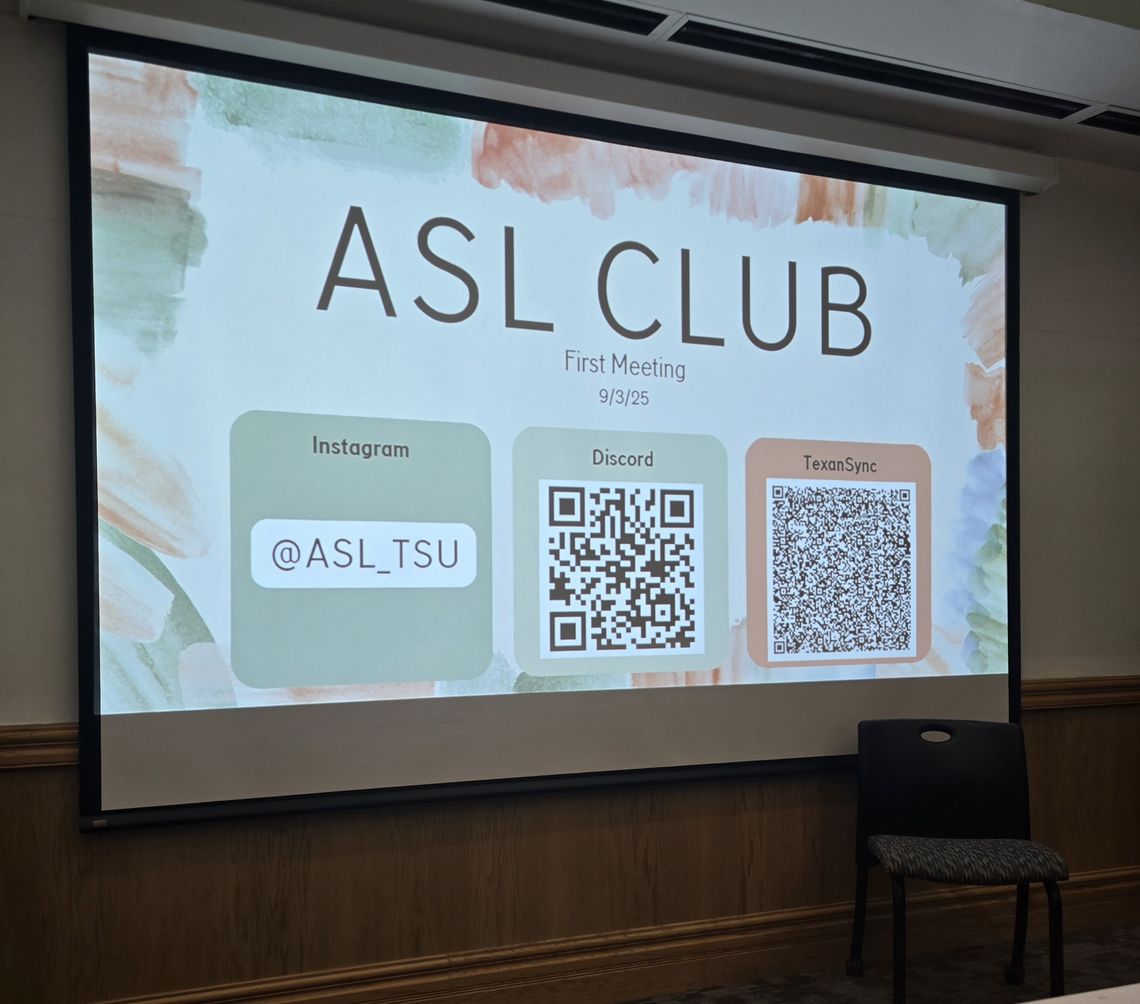
The first meeting of the semester was on Sept. 3, in which Soechting taught the signs of the ASL alphabet to returning students and newcomers alike.
Among the returners were sisters Tiffany and Jadence Depue, who had recently joined the club last semester.
“We’re both hard of hearing, so we figured we might as well go ahead and start learning the language in case we do become deaf; it would be easier for us to do,” Tiffany said.
While she is generally able to converse with others verbally with ease, being hard of hearing has come with some unique challenges as a student. She discusses being unable to hear one of her more soft-spoken professors, even while they were wearing a headset mic and she was sitting in the front row.
For the Depue sisters, Tarleton’s ASL club became a community where they could learn to interact with the world around them in a new way.
“We both participated in signing a song that we performed in a church, so that’s pretty cool. We still have it on my playlist, so we’ll still kind of sign to it a little bit if we’re driving in a car and it comes on,” Tiffany said.
Tarleton’s ASL Club often enjoys partnering with other campus and local organizations for events, such as Valley Grove Baptist Church, the Delta Zeta sorority and Erath County’s Humane Society.
Jadence is studying animal science at Tarleton and found herself some furry friends while ASL Club members participated in the Humane Society’s Cinco De Mayo 5K and Fun Run last semester.
“I was with the Humane Society people and got to handle the dogs in and out of their cage or hold them while people were walking around or going on their runs,” Jadence said.
The Depues are always eager to welcome new members with a kind smile and helping hands.
“It’s good to have patience and be like, ‘Okay, this is where I was in their shoes last semester,’ you know? I wasn’t very good at it either, but I would treat them with the patience I would have wanted when I was not,” Tiffany said.
Tiffany has also expressed her desire to see more captions while watching movies, like in many of the deaf-inspired films Tarleton’s ASL Club has enjoyed together on movie nights.
“Movie nights are really fun because they’re just a time to relax and you’re watching, usually a deaf-inspired movie or something like ‘A Quiet Place,’ where people are using sign,” said Maggie Robisom, ASL Club secretary.
Robisom knew she wanted to learn sign language after an encounter with a deaf woman from her hometown at a restaurant.
“I just thought it was upsetting that nobody could communicate with her, so I wanted to learn ASL in college,” Robisom said.
She joined Tarleton’s ASL Club during her freshman year, with her friend Cara Harris, the treasurer.
“During orientation, they had this little set-up, and I was like, ‘Hey, is there an ASL class?’ and the guy’s like, ‘No, but they do have a club.’ Then I met Cara at Duck Camp, and we ended up going to ASL together. We’ve been here ever since,” Robisom said.
As a returning member of three years, Robisom has not only become immersed in ASL as a language, but also deaf culture and the rich history behind it. She strongly encourages her fellow peers to do the same.
“A lot of people try to cure deaf people. Grace doesn’t wear hearing aids, she doesn’t have a cochlear implant, she doesn’t want to hear, and that is her choice. In history, there have been people who tried to suppress deaf people – didn’t allow them to marry, didn’t allow them to learn sign language, and it was a really bad time,” Robisom said. “She’s not broken. Nobody who’s deaf is broken, and it shouldn’t have to be forced on somebody to be cured.”
Soechting’s favorite thing about Tarleton’s ASL community is the diverse group of people that she gets to meet and connect with each week.
“Many people think that all deaf people are the same, but we’re not. Some people can hear a little bit, some can’t hear anything,” Soechting said. “Some people can talk while some people can’t. So, there’s just a big variety of people, but that’s a common misconception.”
Comment
Comments