.png)
 Gavin Patrick
BY GAVIN PATRICK
Sports Editor
It’s a great day to be a Tarleton State Texan. It’s a particularly great day to be a Tarleton State football fan.
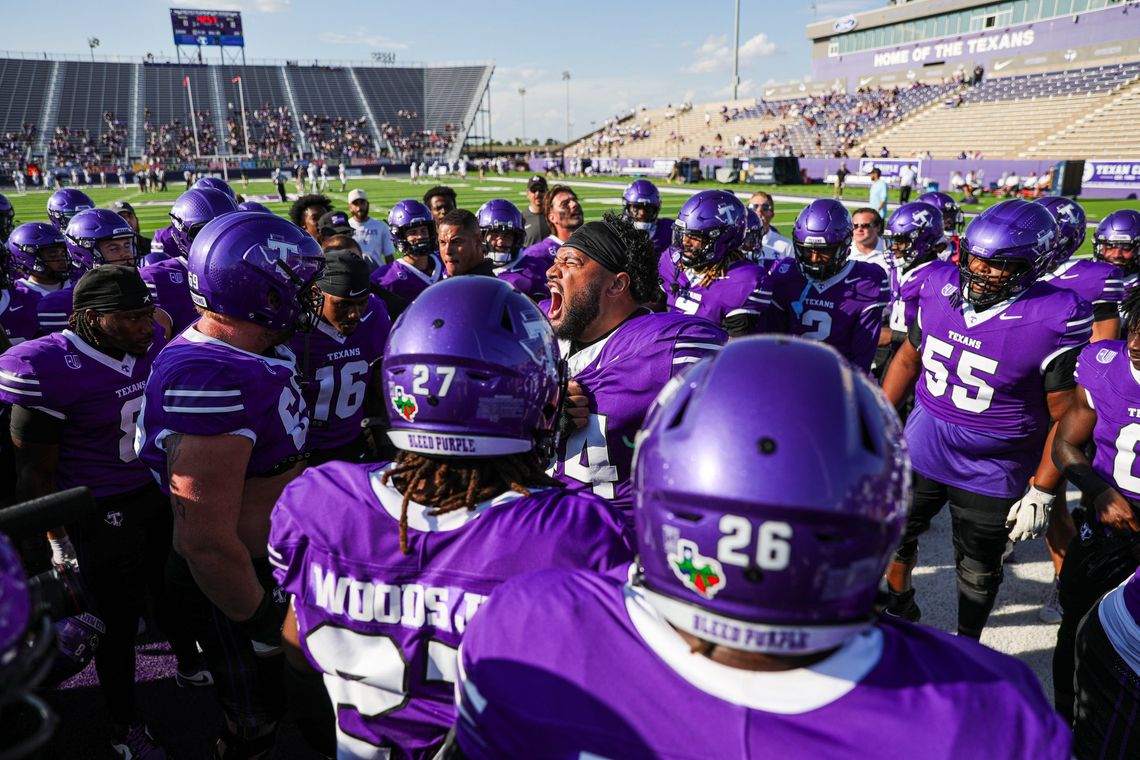
The team is undefeated through five games, have outscored their opponents 239 to 64, attracted a record crowd for family weekend, beat a formidable FBS team in their house and ranks No. 3 in the nation in both major FCS polls.
That said, there’s work to be done—and points to be proven.
Tarleton State is not an unstoppable force. Some may think they can beat any team on their schedule after the Army win and a 46-point can-opening over a conference foe. But no win is one-size-fits-all.
Football is a game of matchups, and the Texans' weaknesses have not been fully tested.
Can Tarleton compete with any team in the FCS? I think so. And they do, too. But to achieve their goal of a championship, the Texans will likely have to get past the two teams that have won 12 of the last 14 FCS titles: the big bads of the division—and the only teams currently ranked ahead of them in the polls.
Yes, I’m talking about the Dakotas: North Dakota State and South Dakota State.
It’s not healthy to compare yourself to others. As the saying goes, just control the controllables. But to say the Texans are already on par with the Bison and Jackrabbits in just their second year as a full-fledged Division I program would be facetious.
Suffice it to say, those teams up north are bound to expose Tarleton’s weaknesses and answer the questions I have about their chances of winning a national title.
North and South Dakota State present a measuring stick to where the Texans are and where they need to go. So, with their dynastic success in mind, here are the three questions I have about the Texans’ prospects to win it all in 2025.
1) Can the offense or defense reach elite status?
Football is a complicated sport, but it’s so painfully simple at the same time. Whichever team scores more points wins—every time. And half the battle is holding the opponent to fewer points than you score.
Every team that has reached the FCS title game the past eight seasons has had a top 10 scoring offense or defense. The winner of the game (outside the 2020 season where teams played a disproportionate number of games) had at least one top-three unit. These teams can average 40 points a game and allow under 20 points a game—and not just against Mississippi Valley State.
The Texans are formidable on both sides of the ball, but it’s too early to tell if either unit has reached the level I just described.
They both have moments. The offense generates a high number of explosive plays (runs of 10+ yards, passes of 20+ yards) off their slow mesh concepts. The defense has a knack for creating turnovers, leading the nation with 17 in the early stages after having the fourth-most nationwide in 2024.
In all, Tarleton’s 47.8 points per game currently ranks fourth in the nation, but it’s come against teams with a combined 3-13 record. The defense has aided the product with four scores of their own, while allowing a mere 9.3 points a contest to teams from their division.
It’s fair to question if this kind of dominant play is sustainable. There’s still a lot for these units to prove against tougher competition—like North Dakota State, which has had similar dominance before against teams competing for championships.
The offense has the best chance to continue their early success, and it starts with finding the next program-greats at the skill positions.
Tre Page III may have already introduced himself as the next Kayvon Britten. Since leading the backfield alongside Caleb Lewis, the freshman has shown off impressive speed and burst and can bounce outside the tackles to turn a negative play into a positive. His 474 rushing yards (94.8 per game) rank seventh in the FCS through five games. The Texans have good depth behind him as well.
The wide receiver spot is more of a question mark. No one has separated themselves following the departure of Darius Cooper. There’s been a lot of shuffling so far, with seven players seeing meaningful snaps.
Peyton Kramer seems to have the most chemistry with Victor Gabalis (go figure, they are roommates). But no opponent is going to fear these receivers. Unless Gabalis can become a game-changer at quarterback (which I’ll discuss later), that spells limitations.
2) Can the big boys be bullies at the line of scrimmage?
Usually, there’s a common denominator with championship-level teams across college and professional football: They push teams around.
Consider teams this decade that have had sustained success at the top of their leagues: the Philadelphia Eagles, Georgia Bulldogs, San Francisco 49ers and, of course, North Dakota State and South Dakota State.
These teams are built on strong defense and imposing their will on opponents. No one wants to win more than they do, and that comes from culture and being physically and mentally stronger than the opponent.
It’s what South Dakota did to knock Tarleton State out of the playoffs last season.
The Texans came out swinging that game, scoring touchdowns on each of their first three possessions. But the Coyotes sustained longer drives, gaining three extra possessions from turnovers, and attrition began to set in.
South Dakota broke off six runs of 10 or more yards on their final four drives, including a 37-yarder and a 70-yard house call that put the game to bed.
The Texans wanted that game so bad, but they just got tired. They needed to be stronger up front, and they got stronger this year.
The average size of a defensive lineman (who plays meaningful snaps) jumped from 281 pounds to 292 pounds. Part of the thinking was to not give up 296 rushing yards in a playoff game again, and they looked strong against Army.
The starting offensive line maintained its size (300-pound average to 299-pound average), but left guard Hunter Smith is the only returning starter. The early returns on the reshuffled group are encouraging (they were moving people in West Point), but there’s a long season ahead with more experienced opponents waiting and potential injuries to deal with.
Head coach Todd Whitten has built one of the healthiest winning cultures in college football. If he can keep retaining his players and supplant those who leave, Tarleton State can become an FCS mainstay. This year, it’s about matching the brotherhood with willpower—and maintaining that energy for 16 games.
3) Can Victor Gabalis make winning plays late in games?
Don’t take this the wrong way. Gabalis has been a highly productive quarterback and amazing teammate for three years in Stephenville. He can take the Texans deep into playoff contention. But when the chips are down, he hasn’t shown the ability to overcome.
In his Texans career (since 2023), when trailing or tied in the fourth quarter or overtime, Gabalis has a 50% completion percentage (33/66), three touchdowns, three interceptions and his passer rating drops from 150.4 to 116.2.
On his three game-winning drives, Gabalis has thrown only three passes for 16 yards. (Though one of those drives took one play and another came from 25 yards to go in overtime.)
The point is, the Texans tend to take the ball out of Gabalis’ hands in the biggest moments.
Late in the fourth quarter against Army, with the game tied, Tarleton had one minute and 44 seconds to go down and win the game. They called zero passes. In overtime, they called eight runs and two passes. The broadcasters were losing their minds over why Tarleton wasn’t being more aggressive.
Are the Texans wary of Gabalis, who’s thrown 34 interceptions in 42 collegiate games, leading the team in big moments? Or do they just have a really strong run game they want to deploy whenever they can? Both things can be true at once.
But for Tarleton State to vanquish the Dakotas of the world, Gabalis will have to be at his best late in games.
One thing Gabalis has done through five games this season is eliminate turnovers. That’s something Whitten said he worked really hard at doing this offseason.
“At the end of the day, it comes down to relationships with your receivers,” Gabalis said during an episode of the Todd Whitten Show. “And that’s where I've grown as a leader and as a quarterback, understanding that you gotta have a leadership quality in you where you and your receivers are all on the same page. That comes from week-in and week-out preparation, and we’ve done a great job at that.”
Gabalis became the first Tarleton quarterback in the Division I era, and first since 2015, to toss five touchdowns in a game against Mississippi Valley State. He said he chases perfection in everything he does, even his handoffs, no surprise coming from one of the most seasoned QBs in the FCS.
“The thing he’s done every year is he’s gotten better and he’s continued to grow, and that’s what good players do,” Whitten said.
Not every game will be 59-3, though.
It is yet to be seen whether the improvements Gabalis has made will translate to playing clean or elevate his play in crunch time against the top teams in the country.
The difference in his play and the opposing quarterback’s could decide a season filled with such high hopes for 48 seniors and everyone who has been along for the ride with one of the nation’s fastest-rising programs.
Comment
Comments