.png)
 Bethany Kilpatrick
BY BETHANY KILPATRICK
Managing Editor
On Feb. 28, the United States and Israel launched an attack on Iran due, what the administration said, was growing nuclear threats in the region. “Operation Epic Fury” targeted military infrastructure in Tehran, Iran’s capital, killing Iran’s Supreme Leader, Ayatollah Ali Khamenei.
News headlines and overwhelming graphics have taken over media platforms ever since. Many find themselves confused as to what prompted “Operation Epic Fury” and the United States’ involvement in it.
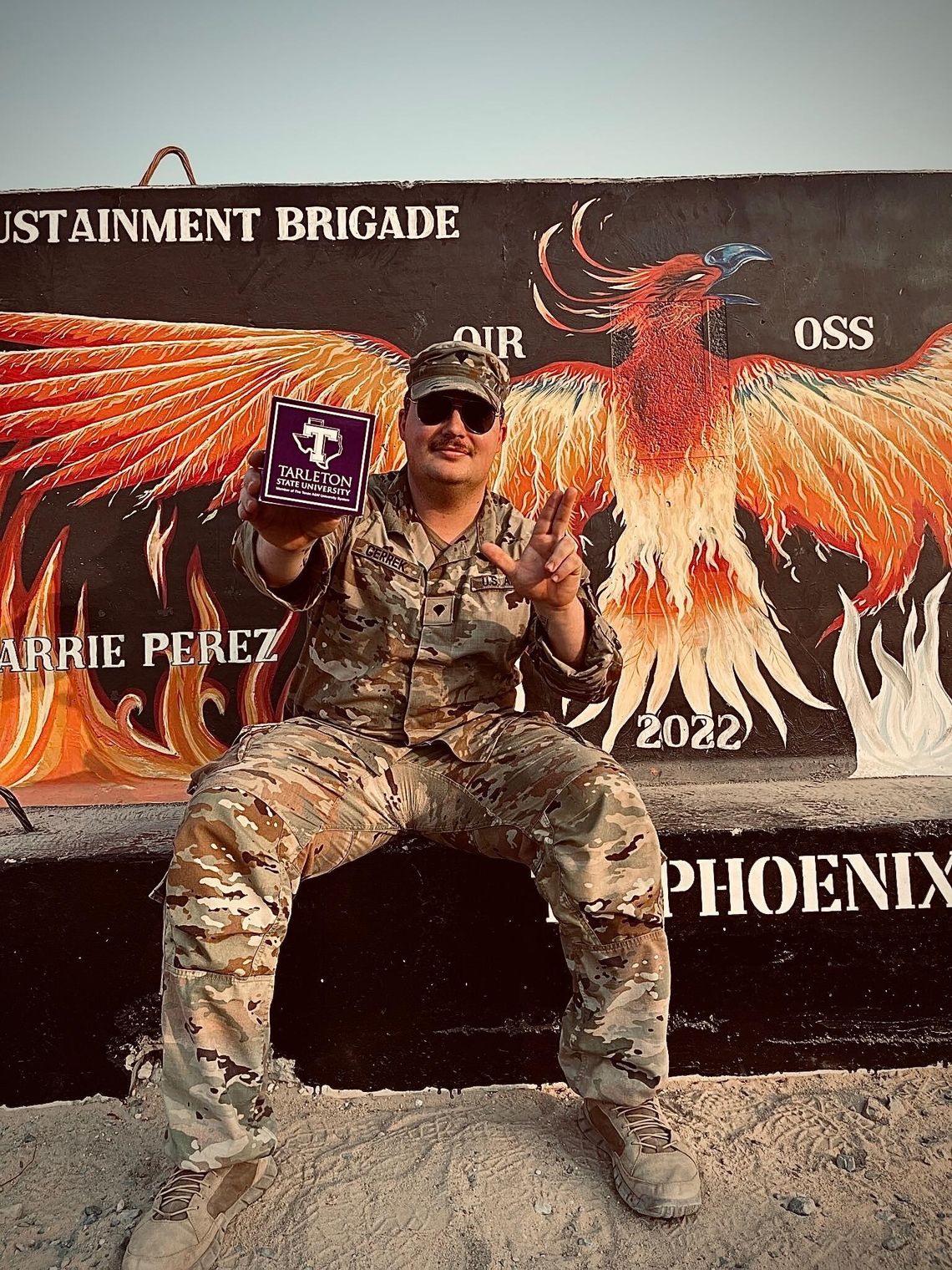
Tarleton State University senior Cole Gerrek has served in the Army National Guard for nine years and is currently still active.
After being deployed in the Middle East more than once, he is able to paint an accurate picture of what is currently taking place and its relevance.
“You have to understand that Iran, for half a century, has been at our throats, has been basically the little brother poking at us, saying, ‘I am going to kill your people, and there is nothing you can do about it,’” Gerrek said.
While the United States and Israel initiated the attack on Feb. 28, Gerrek explained that this attack was not random nor without reasoning.
“Iran has been backed up by Russia and China most of the time,” Gerrek said. “It’s a whole game of chess. It’s strategic. We don’t do anything out of spite. We are not the aggressor. It’s like somebody that you know coming to you and threatening your family. After a long period of time, you are like, ‘Come on. Well, let’s see what you got.’ So basically, that is what has been happening. We’ve had enough.”
According to the Council on Foreign Relations, the United States considers Iran to be the foremost state sponsor of terrorism. The first Trump Administration withdrew the United States from the Joint Comprehensive Plan of Action (JCPOA) in 2018, which was an agreement that lifted sanctions previously imposed on Iran.
This decision was made because the JCPOA did not address concerning issues such as its missile programs. The hopes of retracting from the agreement were to coax Iran to negotiate new terms; Iran’s response was one of retaliation.
Issues and tensions have continued. According to BBC News, “The Iranian leadership has consistently called for Israel's elimination and denounced the U.S. as its greatest enemy.”
Gerrek explained why Iran obtaining access to nuclear weapons, as well as why tensions between Israel and Iran, concern the United States.
“These guys have an ideology of death to America,” Gerrek said. “The best way I know to explain it is, you give the schoolyard bully a big nuke, he thinks he can use it against anybody he wants and there are no repercussions. So it’s a scary situation. The other thing, too, is who is to say they don’t use it on Israel? That’s another scary thought. That country is under the UN [United Nations] Treaty. Unfortunately, we would have to respond to that situation.”
Gerrek summarized the entirety of “Operation Epic Fury” by referring to Pete Hegseth, United States Secretary of Defense.
Hegseth reinforced the idea of “peace through strength,” a philosophy originally used by Roman Emperor Hadrian, and later borrowed by former United States President Ronald Reagan.
After the initial attack on Iran, Gerrek reached out to close friends he had previously made on deployment who are currently stationed in Kuwait, which neighbors Iran.
“I’ve been keeping up with them,” Gerrek said. “It’s been some sleepless nights, because when it’s daytime here, it’s nighttime there. I was staying up during the middle of the night, making sure everything was cool. I remember my first time getting that air raid siren. It was a realization of, ‘Oh crap. This is actually happening.’”
Gerrek understands the realities of being deployed in the Middle East. After enlisting in 2017, he found himself on deployment in Iraq and Syria by 2019 as a part of “Operation Inherent Resolve” (OIR).
“It was everything you expect to see in the movies,” Gerrek said. “The whole showering twice a week, washing your clothes on an old iron rack, using the restroom in a plastic bag and throwing it over the fence. We were in the middle of a village. We were right off the Euphrates, so this was no base. That is where we spent our next ten months or so.”
In addition to the harsh realities already being faced, Gerrek had a new challenge thrown his way: being left behind.
“Due to COVID, we were left behind,” Gerrek said. “We had a whole brigade leave us, make it back home and we were there for an extra month because of COVID restrictions, so that was trifling in itself.”
Gerrek shared the horrifying thoughts that he and many others had to battle every day on deployment.
“You had to wake up with the mentality of, ‘Hey, today is it. Today, do what you can; if it happens, it happens. There were people hating, praying to kill,” he said.
While many students fresh out of high school prepare for college life on campus, Gerrek found himself preparing for college in Iraq.
“I was just sitting there bored one day and saw my buddy’s Instagram,” Gerrek said. “He was posted up at Tarleton. I was like, ‘You know what? I’m going to apply for college.’ Within two and a half weeks of me submitting the application, I got accepted. Tarleton offers a great veteran’s service, so that process was easy.”
While defending his country, Gerrek also began his freshman year.
“It was a hassle sometimes,” Gerrek said. “The communication and internet over there was just so poor. The fall semester, they literally opened up my classes. All the classes said, ‘Hey, get it done by the end of the semester.’ And I was like, ‘You know what? I am going to do this in two weeks, because I don’t have time for this.’ So I did a semester’s worth of work in two weeks on deployment, while maintaining my job with the aircraft. It was a little hectic.”
Though his college career began far from Stephenville, he eventually made his way to Tarleton’s campus.
“I came home in 2023,” Gerrek said. “This town was all new to me. I was like, ‘You know what? I can’t sit in my house and stare at my walls.’ So I decided to look around on campus and try to find things.
After some trial and error, Gerrek found where he fit at Tarleton.
“I found this club,” Gerrek said, “the Tarleton Shotgun Club. I ended up going through and joining the Tarleton Shotgun Club. I really took a liking to it, it was the really welcoming people. It’s a really competitive sport, but I’ve learned a lot. We actually have our nationals this week; we’re competing against 1,800 kids.”
While he is a member of the Tarleton Shotgun Club and a student, he is also still active in the Texas Army National Guard and is currently assigned to 2nd Battalion, 149th Aviation Regiment, a General Support Aviation Battalion (GSAB) based in Dallas, Texas.
Gerrek encourages students to support those who are currently serving and ask questions.
“Kids that go [to Tarleton], their brothers, sisters or parents probably serve overseas,” Gerrek said. “Just reach out and talk to them. Be that support system. We have a great veteran service on campus, so if you ever feel the need to question what’s going on, just stop by. It’s by the financial aid office.”
Gerrek advises his community to follow reputable sources while staying informed of the United States’ involvement in “Operation Epic Fury.”
“There’s a lot of fake accounts out there,” Gerrek said. “Most of your official updates are going to come through CENTCOM. There is a lot of propaganda. Be aware of what you are watching.”
Comment
Comments