.png)
 Jacob Back
BY JACOB BACK
Contributing Writer
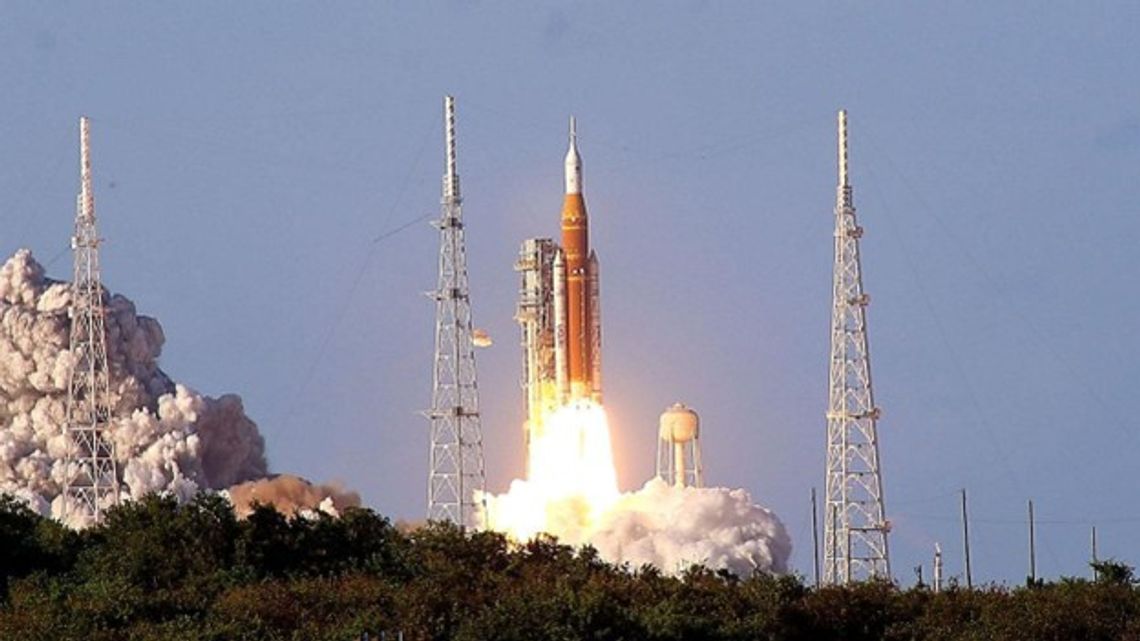
Artemis II was successfully launched toward cislunar space on April 1, 2026. This marks the first time humans have been sent on a lunar mission since 1972, on the Apollo 17 mission.
The Artemis international space program will consist of five deep-space missions, all of which—except for the first mission, Artemis I—are manned.
Artemis I’s purpose was to test the Orion Spacecraft and Space Launch System (SLS) before flying astronauts. After a successful test of the craft, Artemis I landed in the Pacific Ocean on Dec. 11, 2022. This paved the path to Artemis II.
Artemis II took flight from launch pad 39B at NASA’s Kennedy Space Center in Florida at 6:35 p.m. EDT.
President Donald J. Trump addressed the nation on Wednesday evening regarding the ongoing war in Iran, but he made sure to shine light on this historic launch.
“Let me begin by congratulating the team at NASA and our brave astronauts on the successful launch of Artemis II,” Trump said. “They are on the way, and God bless them, these are brave people.”
Even though astronauts did step foot on the moon during the last NASA lunar mission, that will not be the case for Artemis II.
Artemis II is the second mission in a series of five lunar missions constructed to propel humans from the moon to Mars. It will not consist of human contact with the lunar surface, but it will be the first manned Artemis mission, with Mission Commander Reid Wiseman, Pilot Victor Glover, Mission Specialist Christina Koch and Mission Specialist Jeremy Hansen occupying the craft.
The flight path consists of an altitude of anywhere from 3,000 to 9,000 miles above the lunar surface. If successful, this will be the farthest any human has gone into deep space.
The crew's mission is to test life support systems, crew operations and safety systems in deep space to pave the way for the future Artemis missions that will touch down on the moon.
In preparation, the Artemis II crew spent all day on April 1, 2026, preparing for the launch, with activities like playing cards, inspecting their gear for a final time and staying in a quarantine zone for their health.
When the time came, Charlie Blackwell-Thompson, the Artemis launch director, gave the final go-ahead through a muffled headset for the launch.
“Reid, Victor, Christina and Jeremy, on this historic mission, you take with you the heart of this Artemis team, the daring spirit of the American people, our partners across the globe and the hopes and dreams of a new generation,” Thompson said.
They will be in deep space for 10 days completing the mission.
Artemis II is set to make its parachute-assisted splashdown in the Pacific Ocean near the coast of Southern California on April 14, 2026.
Following a successful touchdown back on Earth from Artemis II, Artemis III will take place in 2027, Artemis IV in early 2028 and Artemis V in late 2028.
Artemis V, if successful, will be the first human step on the moon since the Apollo program in 1972.
Even though the first human step back on the moon depends on the successful completion of Artemis II, NASA plans for this to mark a key step toward a long-term return to the moon and future missions to Mars.
NASA plans to have subsequent missions every year after Artemis V.
“Good luck and Godspeed, Artemis II,” Thompson said.
You can watch live updates on the Artemis II mission on NASA’s website.
And while you're waiting for Artemis II to touchdown back on Earth, you can also take the Artemis II Quiz to find out which Artemis astronaut you are.
You can take this quiz as well as watch live updates on the Artemis II mission at NASA’s official website.
Comment
Comments