.png)
 Kellan Byars
BY KELLAN BYARS
Digital Media Director
With brooms, shovels and even sponges in hand, Tarleton State University geology students spent hours clearing dirt and sediment from limestone at Dinosaur Valley State Park.
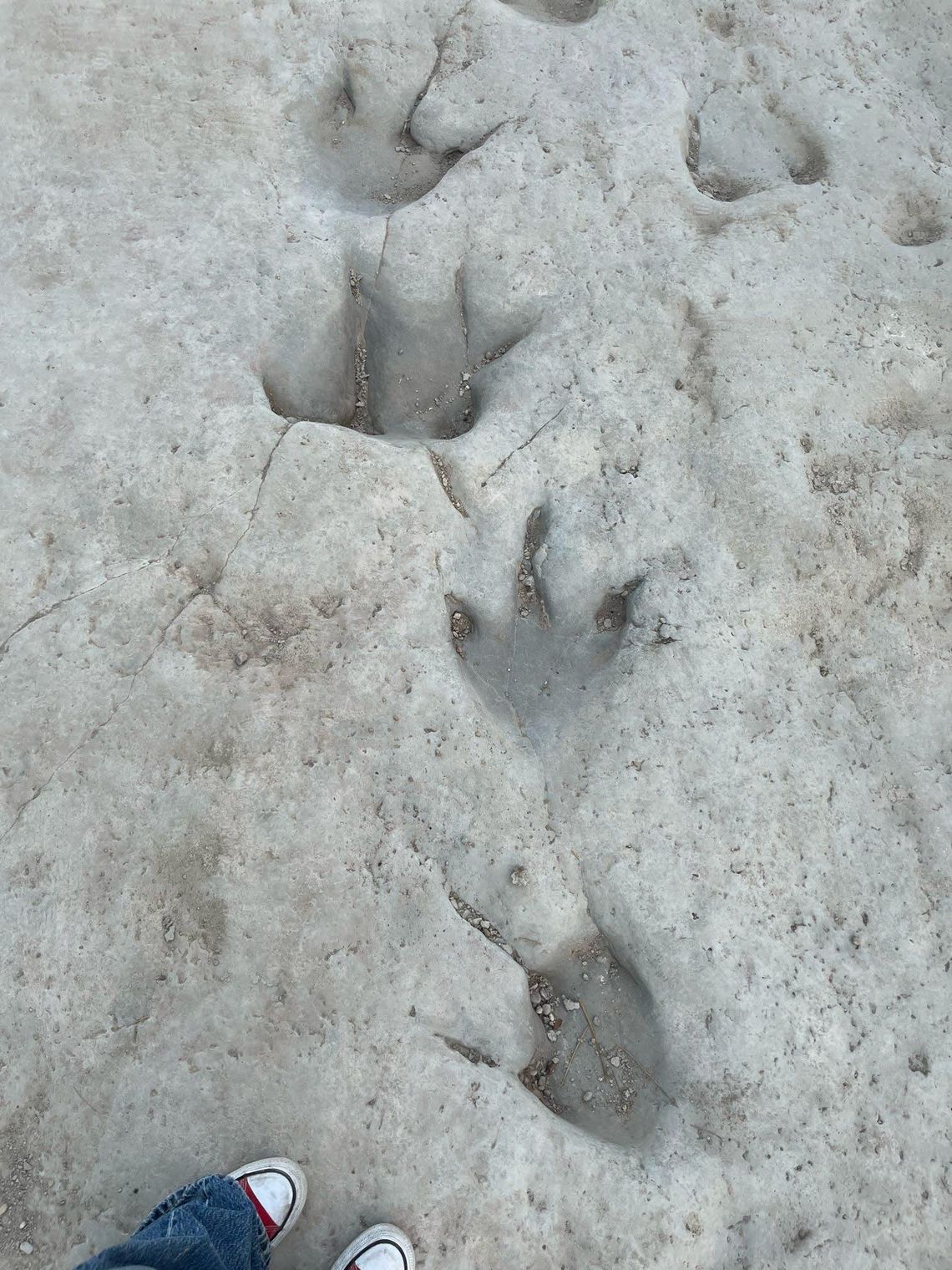
What began as a volunteer opportunity quickly turned into a chance to uncover dinosaur tracks that had never been seen before.
The opportunity arose after a paleontology professor at Tarleton shared the idea with students on campus. The 1,500-acre park needed volunteers to help uncover never-before-seen footprints from various prehistoric animals.
Club President Addie Edwards and risk management officer Kari Davis explained that this opportunity put Tarleton back on the map for a project that would add a lot to the club.
“Tarleton had been involved in the past, and it kind of just dwindled out. We wanted to get back involved with them,” Davis said.
What was expected to be a small group of volunteers quickly became a greater effort. Students consistently brought groups of 10 or more people to the site, despite the work being completely unpaid.
“It was just cool to see how many people were ready to help when it was like, ‘Hey, you're not getting hours for this. This is purely volunteer work, no pay,’” Edwards said. “And it was like, ‘I don't care. This is cool.’”
The work may sound like a scene from Jurassic Park, but students said much of the process involved patience and careful attention.
Students used plastic shovels, brooms and brushes to remove sediment covering the limestone. Metal tools were not allowed because they could scratch the limestone where the footprints were preserved.
The students' work helped prepare the tracks for further research, including overhead imaging and casts or molds that could be used to measure and study the discoveries.
For geology students, however, the experience offered more than an afternoon of digging.
“This is a really good opportunity for them to get boots-on-the-ground experience,” Edwards said. “You can study and know all the terms and stuff, but it's so much different than hands-on experience outside of a lab.”
The students also gained experience working alongside professionals and with other volunteers in a field setting.
For the students, the most rewarding part was not necessarily the physical work. It was what could appear beneath the dirt.
“What you're going to get is the satisfaction of discovering something,” Davis said. “It's so thrilling to go out there and wipe some dirt away, and all of a sudden, it's like a snapshot, like thousands, millions of years in the past and you discovered it.”
That feeling became especially significant when students realized that some of the tracks they uncovered had never been seen before.
“It's just great to be able to see that and be the only people to have ever seen that before,” Davis said.
The experience also created plenty of smaller moments of excitement.
At one point, a student uncovered a small gastropod shell fossil and jokingly announced that he had found a dinosaur toe.
The group knew immediately that the fossil was not a dinosaur toe, but the moment became one of the memorable parts of the experience.
Students also found satisfaction in less conventional discoveries. When water levels in the creek bed dropped, algae left behind the shape of dinosaur footprints, allowing students to reveal some of the tracks simply by moving water away.
The project was also a race against the ever-changing Texas weather.
Recent drought conditions followed by expected rain created a limited window for students to work at the site. With water covering the tracks, students could only work effectively while the area remained dry.
“It was kind of a race against the clock almost,” Edwards said.
The students were encouraged to bring whoever they could whenever they could, including during evening work sessions.
That urgency became clear when rain forced the group to cancel a planned workday because of thunderstorms. When students returned to the site, they found water filling the dinosaur tracks they had uncovered.
The tracks were lower than the surrounding limestone, creating small, footprint-shaped puddles.
“It was so cool to see that,” Davis said.
The students eventually grabbed sponges and began soaking water out of the tracks so they could continue working.
Beyond the discoveries themselves, students said the project provided an opportunity to represent Tarleton's geology program and connect with others in the field.
Members of a paleontological society noticed the work the Tarleton students had been doing and expressed interest in connecting with them and potentially having students join their organization.
Even though the Tarleton students were not working directly alongside the group, their progress was visible.
“They saw our work and our progress while we were working the same thing they did,” Davis said.
For the Geology Club, the project also represented an opportunity to show the passion of students entering the field.
“We have that passion to get out there,” Edwards said. “To have that kind of reignited passion of students and people still being interested and keeping that field alive, I think, is really important.”
For the students who spent hours digging through dirt and sediment, the experience offered something that cannot be replicated entirely in a classroom: the chance to uncover something for the first time.
“It was just such a ‘This is our chance’ kind of moment,” Edwards said. “Not like, ‘it'd be cool if you did this.’ Like, ‘We gotta do this now or never’ type thing.”
The site leader at Dinosaur Valley Park, Paul Baker, was able to express what the experience meant to him.
“As a proud Tarleton alumnus, it meant a lot to watch these Tarleton students come together, putting in long, hard hours and working until dark to uncover dinosaur tracks that no one had ever seen before. Getting to work alongside fellow Texans from Tarleton on a project so deeply important to me, and to the entire paleontology community, made this an experience I’ll always be proud of,” Baker said.
Comment
Comments