.png)
 Gavin Patrick
BY GAVIN PATRICK
Sports Editor
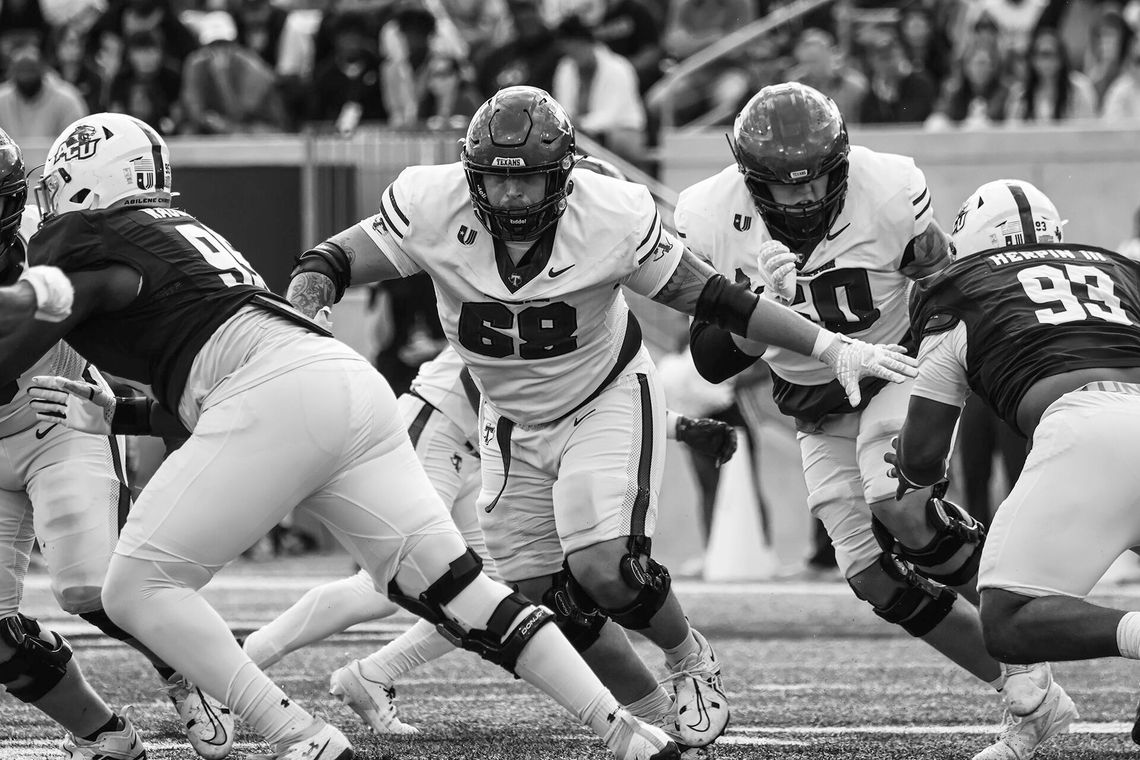
When Texan Nation looks back on the magical run forged by the 2025 Tarleton football team—perhaps going down as the best team in school history to this point—not many people will think of the offensive line.
The offense, as a unit, was extraordinary, putting up a league-best 42.4 points per game, averaging close to 200 yards a game on the ground and only giving the ball away nine times all year.
But the truth, glamour aside, is that Tarleton State asks more of its offensive line than maybe any position group on the team.
One of the more miraculous stats in football is when a team is able to play all five of its starting offensive linemen in every game of a season. Tarleton State did that this year, and the benefits that came from it have not been harped on enough.
“It’s really good to have all five of us healthy the whole season because we practiced all throughout the summer and spring to get that slow mesh down,” left guard Hunter Smith said. “So to have all five of us the whole season, it really helps out the offense. It’s good chemistry.”
The slow mesh concept has been a staple of Tarleton State’s offense for years. Essentially, a slow mesh is an exaggerated take on a run-pass option (RPO). It almost plays out in slow motion, as the quarterback decides whether to pull or keep the ball in the running back’s belly as they converge at the “mesh point.”
This conflict works to isolate a defender with both run and pass responsibilities. And as soon as he commits to a run or stays back for a pass, the quarterback does the opposite and puts the ball in the more advantageous position for the offense.
“The slow mesh really [makes defenses] respect the run,” quarterback Victor Gabalis said, “but then our receivers are going full speed, and they don’t know if I’m handing it off, they don’t know if I’m pulling it, and it just allows for our guys to use speed and basically burn past the whole defense. It’s really hard to defend.”
The challenge for offensive linemen is holding their blocks for an extended period—because if one gets beat quickly, the play is dead. And since they don’t have an immediate tell on whether a run or pass ensues, they have to manage their gap assignments without moving more than three yards downfield—or else they could be flagged for being ineligible downfield if the quarterback decides to throw.
It’s a unique and complicated scheme to master, which is why very few teams across college football run slow mesh concepts today. The Texans do it better than anyone, and it starts with the big uglies up front.
“I would say it’s just being on the right people and staying on the blocks really helps us be successful with the slow mesh,” Smith said, “because it takes a while for the play to develop.”
Having the same five linemen run it every time has been invaluable, because it’s almost become second nature.
“We get used to each other, we get into the same flow, and I think it’s huge,” right tackle Kurt Hatch said. “But our backups, for sure, they can get in there and do it just as good as we can.”
It may be hard to believe in hindsight, but not many people thought things would be this easy for the Texans’ offensive line heading into the season.
Smith, who made all-conference in 2023 and 2025, was the only returning starter on this year’s group. Three of the other four—Hatch, Jordan Love and Braden Smith—saw limited time as backups in 2024, and left tackle Aidan Moe came as a transfer from Northern Colorado.
The natural expectation for a reshuffled o-line is that it’ll take time for the unit to yell and learn how to play together. But not this group. The Texans came out firing, averaging 234 rushing yards and allowing only five sacks through the team’s first eight games, all of which were Texan wins.
“Coming out of fall camp, I don’t think we were the favorite unit,” Love, the center, said. “And I think our average for scoring [42.4 PPG], that’s a big total for our group, and I think we came out and really showed everyone else what we can do.”
Offensive line coach Scott Carey shouldn’t be overlooked for the job he’s done, either.
Carey has been the o-line coach the past eight seasons at Tarleton State. He helped lead the biggest turnaround in program history in 2018, where all five linemen earned all-conference honors at the Division II level, and has since continued to lead top units every year through the transition to Division I.
“I would say our coach really preaches on us playing physical and playing to the whistle,” Smith said. “When you play physical and play to the whistle and we got those good backs in the backfield, they usually make something big happen through that.”
Football is as team-oriented as a sport gets. Perhaps nothing illustrates that more than the offensive line. A running back can’t spring through holes without blocking, and a quarterback can’t become a program’s all-time leading passer without a clean pocket every now and then.
Sometimes all a good unit needs is reassurance, and that’s a message the Texan o-line has earned from years of production and seamless transitions.
“Just gotta be us,” Love said. “Don’t be anything special, just be us. And we know we’re a good offensive line. So if we’re us, we’re gonna do good.”
Comment
Comments