.png)
 Hannah Brooks
BY HANNAH BROOKS
Multimedia Journalist
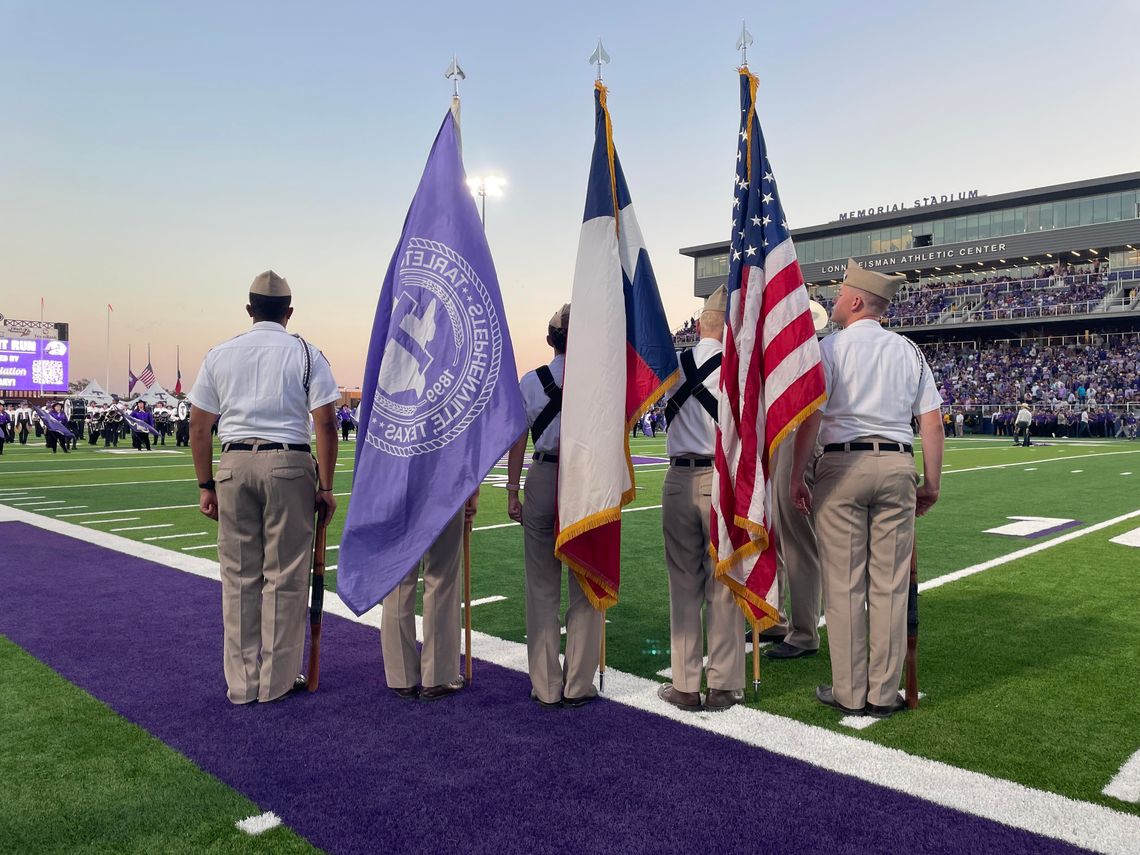
The Tarleton State University Texan Corps of Cadets is entering the 2026 fall semester with its largest freshman class in program history and a female enrollment rate that leaders say is well above that of comparable military programs across the country.
The Corps began the year with 103 freshmen and currently has 99. Last year, the Corps started with 95 freshmen and finished with 86.
“It’s about a 7% increase, which is the largest growth of any Corps in the nation,” said Capt. Brian Peters.
But another number has caught the attention of Corps leadership even more.
“The average number of females in the ROTC programs [nationally] is 7% and just looking at the Corps it’s 17%. Ours is 31%, making our female Cadets our largest population of growth,” Peters said.
Lt. Col. Joel Humphries (U.S. Army retired), deputy commandant of cadets and chief of staff, said most Corps of Cadets programs typically have between 7% and 14% female cadets. The Department of War, he said, is about 17.1% female.
“So if you take a statistical breakdown, it's an outlier. We’re trying to figure out the ’why’?” Humphries said.
According to Corps leadership and the Cadets themselves, the culture at Tarleton is the driving factor for the Corps’ exponential growth.
The Corps’ West Point victory has helped raise its profile, while the distinctive identity of Tarleton State’s Corps gives prospective Cadets another reason to look at the program.
“There's something going on that makes us more approachable,” Peters said.
According to Humphries, Tarleton does not use some of the traditional practices associated with military training. Cadets' heads are not shaved, cadets are not screamed at or yelled at, and physical training is not used to “smoke” cadets as motivation.
“We're training for the leadership methods of now and forging our own way as a military school,” Humphries said.
Instead, the Corps’ leadership emphasizes team building, mentorship and leadership.
“We cannot try to compete with the military colleges.” Humphries said. “Their history is long and storied and we cannot compete that way. So why not create a different way?”
For freshmen, that difference starts at Duck Orientation Training. Cadets participate in team-building activities each night, with their first night including the First 100 Yards, which requires them to learn about campus and one another while working together. They also spend time with the Tarleton volleyball team, participate in rifle instruction and play dodgeball.
“The whole theme is that we don't do unhappy cadets,” Humphries said.
Freshman cadet Magdalyn Smith describes a Corps where Cadets are expected and even eager to help each other in their physical training.
They wake one another up for PT, run together and create workouts for their groups. When someone struggles, the goal is to help them keep going rather than leave them behind.
“It's so much easier when there's all these people who also want to see you succeed,” Smith said.
Smith says the competitive nature of PT does not mean Cadets want to see one another fail.
“We're not like, ‘Oh, well, they're just a dud,’” she said. “We're trying to all push each other.”
That mentality extends to discipline. The freshmen described consequences for mistakes but said they are generally connected to the mistake rather than intended to humiliate the Cadet.
“They understand we're gonna make mistakes, even telling us the time and place to make mistakes and ask questions is now,” freshman Cadet Marin Seagraves said.
Peters and Humphries reinforce this teaching method.
“Failure is the greatest tool to learn we'll ever have,” Peters said.
According to Humphries, the Corps' changing demographics and zero-tolerance policy for hazing and Title IX issues are key factors to its culture. The Corps teaches Cadets what hazing is, what is prohibited and what they are expected to report. But its philosophy goes beyond simply prohibiting hazing. The goal is to create an environment where authority does not have to depend on volume.
“We believe everybody here's an adult and future leader with expectations and standards to uphold.” Humphries said.
That philosophy can be seen in the way Cadets interact with one another. Older Cadets are expected to teach younger ones, but they are also expected to help them.
The Corps’ emphasis on mentorship and its adaptive culture has also played a role in bringing students to Tarleton from other programs.
“We have one student who transferred here from A&M and another from Prairie [View] A&M,” Humphries said.
“We are not just instructors; we are mentors,” Peters said.
That mentorship is not limited to military training. Peters said Cadets come into the office to talk about academics, personal problems and other issues they are dealing with.
For some of the freshmen, that support has helped make the transition to college, and, for some, a move across the country, easier.
As an out-of-state freshman, Smith said the Corps has become another support system away from home.
The feeling became especially clear when she worried that her parents would not be able to attend an important Corps ceremony.
She brought the concern to her sergeant, and many quickly volunteered to place her pin themselves.
“It generally is another family,” she said.
The number of women in the program has also created its own cycle of recruitment.
“The more women that come, the more women that will keep going because they see the others,” Peters said.
Humphries said Tarleton's female Cadets have been foundational to its leadership positions. The Corps had three female Corps commanders in succession, including its first female-to-female transition and its first female cadet of color to serve as Corps commander.
He emphasized that those selections were not made because the Corps wanted to meet unwritten standards.
“We are purely about who's the best and who's the best fit,” Humphries said.
Still, the presence of women in leadership can make a difference to younger Cadets.
Smith says one of the first things that stood out to her was the amount of support they received from older female Cadets.
During their first week, the female freshmen met with a female mentor group that helped them learn some of the practical parts of being a Cadet.
“The first week we all met, and it literally was just, ‘Hey, this is how you do your hair,’” Smith said.
Freshman Cadet Karin Braverman points out that the difference was noticeable in the uniform itself.
“It sounds unimportant, but the polo that we have to wear on Thursdays, all the women have like a V-cut instead of a button up polo,” she said. “So you don’t feel like you're dressed like a boy.”
Those details may seem minor, but they are part of what the freshmen said makes the Corps feel more welcoming towards women.
In terms of physical rigor and standards, Seagraves notes that they are equally held to excellence.
“Nobody treats you differently or as less than just because you're a girl,” Seagraves said.
The support they receive is not limited to older female Cadets.
Smith said male cadets have also played a major role in helping the women feel comfortable in the Corps, citing their protective attitudes and consistent encouragement.
She joked, “We even get annoyed because they act like our fathers sometimes,”
Seagraves recalled one sergeant checking on the freshmen before they went out one night.
“If you need anything, I'm here,” she said the sergeant told them.
Humphries says the Corps' integration with the university, its approach to training and its emphasis on team building all contribute to the growth phenomena.
But he said there is no single recruiting trick responsible for the numbers.
For a program that is growing at the rate Tarleton State's Corps is, the culture they’re cultivating appears to be becoming its greatest recruiting and retention tool.
Comment
Comments