.png)
 Gavin Patrick
BY GAVIN PATRICK
Sports Editor
You thought March Madness was a basketball thing? Think again.
The NFL is still in full swing this time of year, just not on the field. Spring is a time for all 32 teams to regroup, reset and address their needs through free agency. But every team is in a different place, and each defines offseason success by different terms.
In this exercise, I assigned one team to every letter grade—pluses and minuses included—to assess their performance in free agency based on need-filling, savvy business and whether or not the moves helped steer the franchise in an appropriate direction.
This doesn’t necessarily mean adding players who will help win games right away.
To be clear, more than one team deserves a B-minus, but I chose the team that is most discussion-worthy for this exercise. So, if you’re wondering: Yes, the Dallas Cowboys made the cut — just not for the right reasons, as is the case for other teams.
There is a trend worth pointing out for all three teams with an A: Every one of them addressed the trenches.
If you watched the Super Bowl, it’s no secret that besides quarterback, offensive and defensive lines are the most important position groups in football. It’s a big boy sport (one my body frame couldn’t handle).
A common denominator for playoff teams is winning the line of scrimmage consistently, and that vision was evident for the teams with the highest report cards.
With that, here is every grade in the gradebook defined by an NFL team’s latest moves.
A+
Team: Minnesota Vikings
Here is yet another case study of what having a quarterback on a rookie deal can do for a team. Dumping Sam Darnold made room for the Vikings to sign immediate-impact veterans like Jonathan Allen and Javon Hargrave, bolstering the spine of the defensive line.
Minnesota also addressed the offensive line’s interior with Ryan Kelly and Will Fries, while re-signing Aaron Jones and Byron Murphy to multi-year deals. Also, trading for Jordan Mason is a sneaky good move, who filled in quite well for Christian McCaffrey last year in San Francisco.
The only question mark on this roster is quarterback, at least from an outsider’s view. The Vikings sure seem bought-in that J.J. McCarthy can lead the team farther than Darnold — because their words have aligned with their actions in free agency.
A
Team: New England Patriots
New head coach Mike Vrabel wanted to support his young quarterback from the inside out — and on both sides of the ball. Super Bowl hero Milton Williams was the big splash, who pairs excellently with Christian Barmore on the defensive interior, especially if the latter can return to his pre-blood-clot level in 2023.
The addition of Carlton Davis, the Lions’ best corner last season, also forms a one-two punch at cornerback with All-Pro Christian Gonzalez. And veterans Robert Spillane and Harold Landry are serviceable improvements to their position groups.
Help for Drake Maye is coming, too, including established linemen Morgan Moses and Garrett Bradbury, just not in the manner some wanted to see.
The Patriots barely missed out on two of the cycle’s best players, Ronnie Stanley and Chris Godwin, who both opted for hometown discounts with their current team. They eventually settled on a three-year deal for Stefon Diggs, but there’s still ground to make up in the draft.
A-
Team: Chicago Bears
The Bears attacked their top priority, which was to surround second-year quarterback Caleb Williams with a better offensive line. The interior was completely revamped and now looks like a strength. Trading with the Chiefs for Joe Thuney, a five-time Super Bowl champion with excellent veteran leadership and versatility, was one of the best moves of the cycle.
Chicago also traded for Jonah Jackson and signed Drew Dalman, an athletic center who fits new head coach Ben Johnson’s run scheme like a glove. Defensively, they inked three-year deals with 25-year-old edge Dayo Odeyingbo and 10-year veteran Grady Jarrett at tackle.
These weren’t flashy but supplemental pieces for new and accomplished coordinator Dennis Allen to work with for a unit that punched below its weight a season ago.
B+
Team: Denver Broncos
Denver followed through on their surprise season with win-now moves. They bolstered last year’s top 10 defense with former 49ers Dre Greenlaw and Talanoa Hufanga, who were big contributors on a championship caliber unit two years ago. They aren’t slam dunks, though, as both spent last season battling injuries (although Greenlaw did come back strong in the final two games).
That rings a similar bell for new tight end Evan Engram, who suffered a torn labrum in December following a 114-catch season in 2023. Head coach Sean Payton may finally have his “joker” if the tight end can return to form and second-year quarterback Bo Nix could benefit from his underneath presence and versatility.
The Broncos also retained defensive tackle D.J. Jones to a three-year deal.
B
Team: Los Angeles Rams
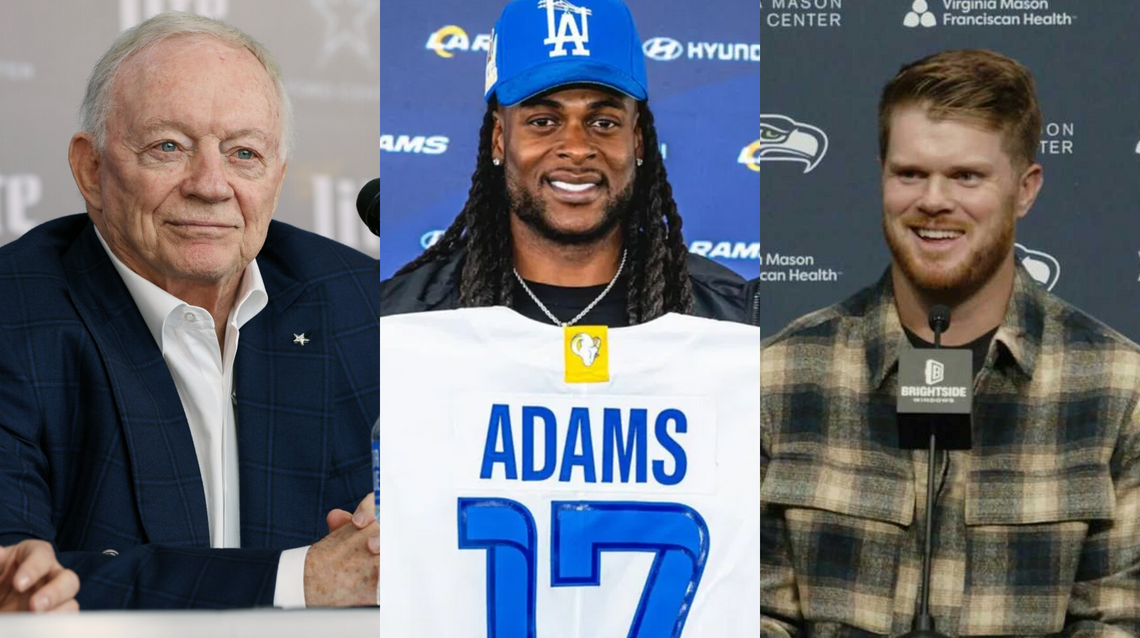
The Rams look like the favorite in the NFC West thanks to a strong free agency cycle. Retaining Matthew Stafford enabled them to pull the best wide receiver off the market, Davante Adams, and outstrip the value of fading franchise hero Cooper Kupp.
Paired with Puka Nacua, the Rams give their 37-year-old quarterback one of the best wide-receiver duos in the NFL. The Rams have operated from an aggressive win-now model for years, and Adams fits that mold perfectly, as he does in head coach Sean McVay’s creative offense.
LA also addressed their leaky run defense with one of the best run-stuffers in the game, Poona Ford. Ford’s steady interior presence was a missing piece last year for the young and hungry pass rush.
He and Adams were the only players the Rams added from outside the building. The grade may have been higher had they managed to add more.
B-
Team: Washington Commanders
The reigning rookie-of-the-year quarterback, Jayden Daniels, had to be delighted with his team’s splashy trades for wideout Deebo Samuel and left tackle Laremy Tunsil. Both are primed to contribute immediately to an exciting offense, but both also have reason for concern.
Samuel is pretty beat up from injuries, even dating back to college, and averaged a career-low 44.7 receiving yards per game in 2024. Tunsil is still one of the best at his position at age 30, but the Texans were willing to let him go despite him being the lone bright spot on one of the worst units in football.
Tunsil has also been one of the most penalized players in the league for years. If Tunsil and Samuel both play to their talent, it’s easy to envision Washington taking a step forward in 2025. But it’s a bit of a dice roll for a team looking to take full advantage of Daniels’ rookie contract.
C+
Team: Las Vegas Raiders
There weren’t many good options for Vegas to significantly improve what was maybe the worst quarterback room in the league a season ago. But they flipped the table by trading for Geno Smith.
The Raiders invested a third-round pick and $15 million in guarantees (under Smith’s current contract), which feels about right for a top-12-to-15-level quarterback. Plus, Smith will play for a future Hall of Fame coach, Pete Carroll, whom he previously had success with in Seattle and credits with rebuilding his confidence after disappointing as a second-round pick. Smith brings much-needed stability to the offense.
The Raiders also added starting guard Alex Cappa on offense and versatile safety Jeremy Chinn on defense. The roster still feels a ways away from being seriously competitive, especially after some key departures on defense. But it’s a better team today than it was in January.
C
Team: Seattle Seahawks
The Seahawks had a rather peculiar offseason. It’s hard to say if the team is in a better place now than it was before. It’s just different and a bit uncertain. The front office parted ways with longtime wide-receiver duo DK Metcalf and Tyler Lockett before adding Cooper Kupp to pair with emerging slot specialist Jaxon Smith-Njigba.
But the bigger shake up was at quarterback, deciding that Sam Darnold is a better investment than the aforementioned Smith, being younger, possibly cheaper and a better fit for the scheme new offensive coordinator Klint Kubiak will install.
However, the offensive line remains a big weakness. Darnold’s worst games in 2024, and throughout his career, have come when he faced constant interior pressure. For a scheme that is very reliant on strong blocking to give the quarterback time to find chunk throws off play-action, the Seahawks feel like an unfinished product.
Their only addition to the o-line was Josh Jones, who played swing tackle for the Ravens last year and started zero games. Luckily, Seattle has plenty of draft capital to continue retooling. But these are big changes to make for a coordinator who was just fired by the Saints.
C-
Team: Houston Texans
The further demise of Houston’s already porous offensive line has been well-documented and caps their grade at a low mark. But the Texans did a better job in free agency than they are being credited for.
The addition of Christian Kirk at wide receiver gives C.J. Stroud a field stretcher from the slot, which will help open dig patterns for Nico Collins. And getting out of the Tunsil contract gave Houston flexibility to sign and extend a slew of impactful defenders, none bigger than the addition of C.J. Gardner-Johnson. Demeco Ryans is built on defense, and his unit looks scarier than ever.
In fact, the offensive line may not be tanking after all, with the additions of Cam Robinson and Trent Brown remaking the tackle positions. Both players look more like Band-Aids than long-term answers, and there’s still plenty of work to do on the interior, but I don’t fault the Texans for prioritizing personnel that fits the identity of their head coach.
D+
Team: Cincinnati Bengals
Hear the Velcro rip? That was the sound of owner Mike Brown finally opening his wallet. It looked like the 89-year-old was stuck in his ways again after tagging Tee Higgins a second straight year and allowing Trey Hendrickson to seek a trade partner. But the Bengals finally gave in to the inevitable.
Ja’Marr Chase is now the highest paid non-QB in league history at four years, $161 million. And Higgins’ four-year, $115 million deal is guaranteed for the first two years. The only problem is the Bengals shot themselves in the foot by waiting so long.
Chase demanded the highest non-QB salary last year, too, which meant leapfrogging Nick Bosa’s $34.2 million APY. That number rose by six million this year after Myles Garrett signed for $40 million a year on March 9. Cincinnati also declined to pay Hendrickson last year, and with all signs pointing to his return, he’ll demand another oversized chunk of the pie.
Brown’s business strategy was poor and outdated, and he’s, literally, paying the price.
D
Team: Cleveland Browns
It sure seemed like Myles Garrett was set on leaving Cleveland after requesting a trade in February. Money wasn’t the issue (we were told); it was his desire to play for a contender. Well, he either changed his mind or lied because he agreed to a four-year, $160 million extension with a team in quarterback purgatory and many other holes on its roster.
The Browns deserve credit for resolving the situation as promised, but the fact they even had to go through that saga with the face of their franchise further exposed their dysfunction. Cleveland is still feeling the ramifications of the horrendous Deshaun Watson trade. (It’s like what happened to Germany after World War I.)
They are severely hamstrung in their ability to bring in quality veterans, and the best they could muster this cycle was a trade for backup-level QB Kenny Pickett and a two-year, $20 million deal for defensive tackle Maliek Collins.
More or less, it’s the same 3-14 team from last year.
D-
Team: Dallas Cowboys
Last year, it was “all in.” This year, it was “selectively aggressive.” The results were the same. It’s hard to get excited about the Cowboys after they, again, failed to supplement their franchise pillars—Dak Prescott, CeeDee Lamb and Micah Parsons —with quality pieces.
Dallas started the cycle with the 10th-most cap space in the NFL after restructuring Prescott and Lamb’s monster contracts. This made it more feasible to extend homegrown talent like Osa Odighizuwa (four years, $80 million) and Parsons (whose deal is expected to come). But they had a greater ability to bid for top free agents than they let on.
Dallas reportedly had an interest in Cooper Kupp but no intention to match the price of the highest bidder. Solomon Thomas and Dante Fowler Jr. were respectable additions to a defensive front in need of reinforcements, but letting running back Rico Dowdle walk in favor of Miles Sanders and Javante Williams for a higher price was one of the most head-scratching moves of free agency.
For a team looking up at two Super Bowl contenders in their division, the Cowboys seem content sitting back at a distant third place.
F
Team: New Orleans Saints
General manager Mickey Loomis doesn’t seem to have the right read on his football team. The Saints have been in salary cap hell for years, and their recent moves have only prolonged the problem.
Why overpay for Chase Young (three years, $51 million) and Juwan Johnson (three years, $31 million) when the team isn’t a couple of mid-level veterans away from contending? Justin Reid was a solid signing on paper, but New Orleans isn’t suited to utilize him in the ways he was successful in Kansas City. And that’s at least $22 million dollars on their paycheck.
It’s just not what the organization needs right now.
The team is getting older and more expensive when it should be getting younger and cheaper, especially while debuting a first-time head coach. Perhaps the front office sees an opportunity to win the NFC South, a division that hasn’t had a team go over 10 wins since 2021.
But the Saints are not a win-now team. They would be much better off starting over than retooling for more of the same.
On the bright side, maybe hometown legend Arch Manning can turn things around in 2026 when they pick at the top of the draft.
Comment
Comments