.png)
BY ASHTYN HANSARD
Digital Media Director
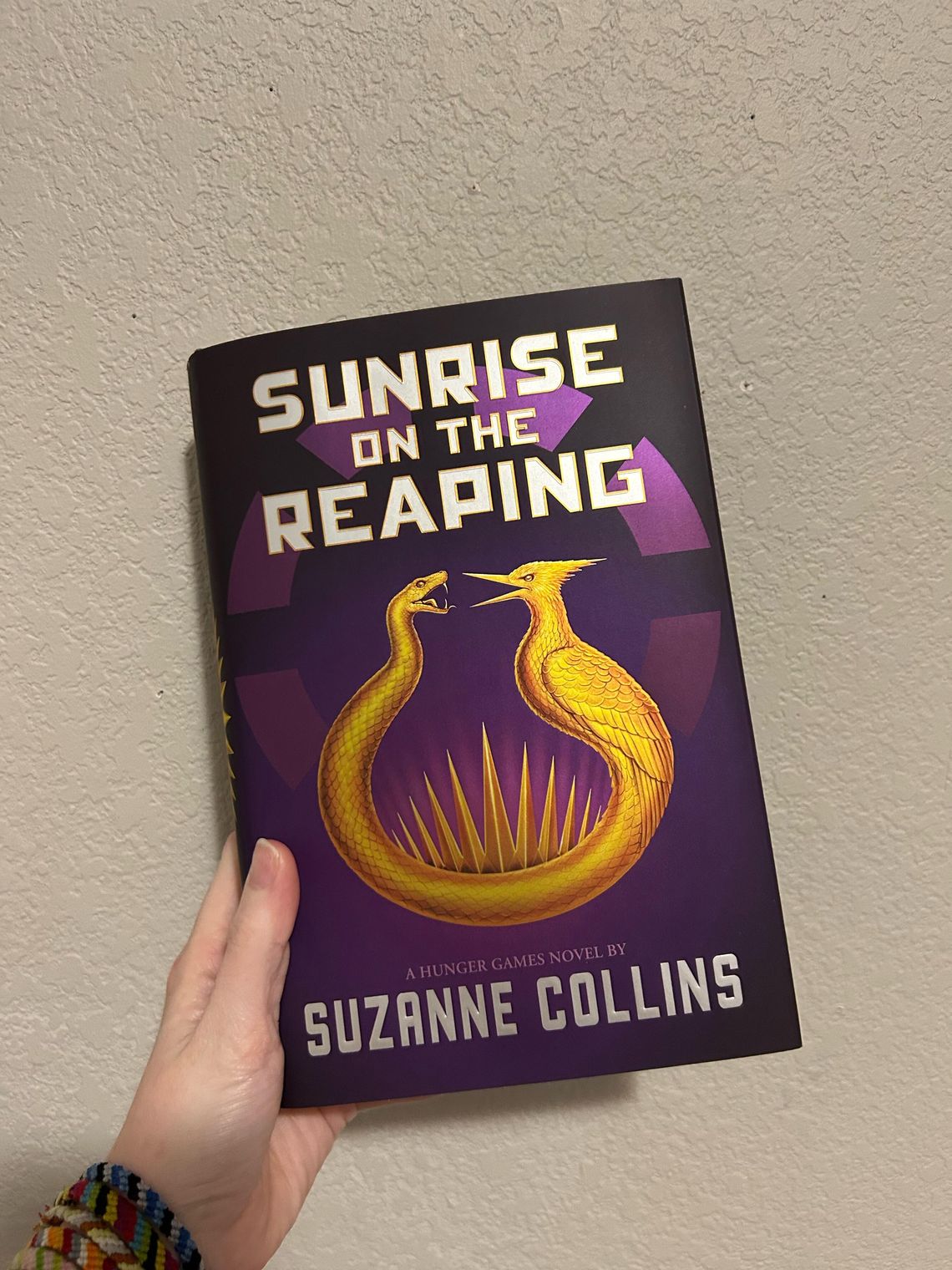
On June 6, 2024, Suzanne Collins surprised the world with news of a new addition to the “Hunger Games” series, “Sunrise on the Reaping.” As a massive “Hunger Games” fan, I immediately pre-ordered two copies. Finally, after a long wait, the prequel was released on March 18, 2025.
If you need to know how excited I was for this book, I read the entire thing in two days.
“Sunrise on the Reaping” is a prequel to the original “Hunger Games” series and revolves around District Twelve’s only living victor, Haymitch Abernathy, who won during the 50th Hunger Games, also known as the Second Quarter Quell.
WARNING: There will be several spoilers within this review. Please proceed with caution.
Before readers even dive into the contents of this prequel, Suzanne captures her audience with her dedications, referencing George Orwell, William Blake and David Hume. After reading the book, it fully makes sense why.
Anyone who reads Collins’ work knows that she only writes when she has something to say. Her statement is simple: Collins is highlighting how easily the media can manipulate the truth and why we can’t always trust it. We’ll touch on this more later in the review.
Haymitch Abernathy. How do I even begin to describe this beloved figure? Many may know him as the drunk from District Twelve or even the father figure Katniss Everdeen longed for after her own father died. After reading his prequel, I can only describe him as tragic.
When starting the book, the reader learns that Haymitch has a mother and a younger brother named Sid. His father died in the mines when he was younger, just like Katniss’. He has a true love named Lenore Dove Baird that he’s destined to be with forever.
Haymitch also has several connections to more minor characters in the original series. Some examples are his best friend, Burdock Everdeen (yes, THAT Everdeen), Asterid, Katniss’ future mother, and the Donner twins, Merrilee and Maysilee, the original owner of the mockingjay pin.
During the reaping, two boys and two girls are called instead of the normal one of each. While the girls, Louelle McCoy and Maysilee Donner, are drawn normally, the boys leave a surprise for the reader.
Instead of Haymitch being called, the boys Wyatt Callow and Woodbine Chance are called.
Woodbine makes a rebellious decision that results in Haymitch being reaped instead, even though it’s against the rules.
I wanted to mention this whole portion of the book to draw an interesting connection between the District Twelve victors. Lucy Gray, Haymitch and Katniss were never supposed to be in the games.
Lucy Gray was picked because the mayor didn’t like her and lied about the name on the slip. Haymitch was illegally reaped to replace Woodbine. Katniss volunteered to save her sister. While Peeta was reaped, he would have died if Katniss hadn’t used the poisoned berries to play the Capitol.
None of these three tributes were supposed to be in the games, yet they all survived and helped play their parts in the revolution.
While reading this book, I couldn’t help but see just how connected Haymitch is to the original trilogy. One example is the characters.
While Maysilee is mentioned in the original series, not much is said about her. However, there are a few characters that were extremely important to the original series, specifically “Catching Fire” and “The Ballad of Songbirds and Snakes.”
While having a Capitol escort, District Twelve also has a propaganda team that is led by none other than Plutarch Heavensbee. Plutarch was also the Head Gamemaker for the third Quarter Quell (“Catching Fire”) and a leading rebel for District Thirteen (“Mockingjay”).
While Plutarch himself wasn’t in “The Ballad of Songbirds and Snakes,” his family was, and they were some of the richest in the country.
Others that are mentioned are his mentors. District Twelve, at the time, had no living victors to mentor the tributes, so they were given victors from other districts. For these games, District Twelve was given Mags and Wiress, who are later reaped and killed in “Catching Fire.”
Another character is Beetee, who is also reaped in “Catching Fire” but survives and helps lead the revolution. However, Beetee’s part in this prequel is nothing short of heartbreaking. I won’t say too much, but be prepared for some emotional moments.
There’s also the return of the well-known President Coriolanus Snow, who is terrifying in this book. During a meeting with Haymitch about his behavior, Snow mentions something about Haymitch’s girl, Lenore Dove.
As he speaks, he mentions several descriptions of the Covey, Lenore Dove’s family.
“Bet I know a thing or two about your dove…Like she’s delightful to look at, swishes around in bright colors, and sings like a mockingjay. You love her. And oh, how she seems to love you. Except sometimes you wonder, because her plans don’t include you at all.”
This quote is especially important after reading “The Ballad of Songbirds and Snakes.” Here, we can see how Lucy Gray, his old tribute and lover, is still haunting him and the whole narrative.
Speaking of Covey, I especially love the character Lenore Dove. She’s a wild and rebellious girl, no doubt getting her spark from her long-lost cousin, Lucy Gray. However, I think the most important aspect of her is her name.
If you’ve read “The Ballad of Songbirds and Snakes,” you may recall that all the Covey members inherit their first name from a ballad and their second name from a color. For Lenore Dove, she inherited her first name from Edgar Allan Poe’s famous poem, “The Raven.”
While the poem has since been turned into a ballad in the “Hunger Games” universe, its meaning still remains the same.
In her ballad, the narrator is mourning their lost love, named “Lenore.” The narrator grows mad with grief over his loss and can’t handle it anymore.
“Respite—respite and nepenthe from thy memories of Lenore; Quaff, oh quaff this kind nepenthe and forget this lost Lenore! Quoth the Raven ‘Nevermore.’”
This line is specifically important for Lenore Dove’s ballad, as it predicts Haymitch becoming a drunk after her death at the end of the book.
Nepenthe is a type of liquor in the “Hunger Games” universe and is mentioned a few times throughout the book. Haymitch ends up becoming a heavy alcoholic after his family’s tragic end and spends a lot of time drinking to forget everything.
Another point of foreshadowing with this poem is in the title, as ravens are often viewed as symbols for death. With the raven approaching the chamber doors, as mentioned in the poem, it symbolizes death arriving to Haymitch, although it’s come for his loved ones rather than him.
The symbolism with the raven also ties into the entire series using birds as symbolism for the District Twelve characters.
Katniss is obviously a mockingjay. While it’s not technically a real bird, it’s the face of the revolution that Katniss leads. Lucy Gray is a songbird and references herself as one throughout “The Ballad of Songbirds and Snakes.” Haymitch, I believe, would be considered as a raven. The deaths of his loved ones at the end of the book occur when he arrives to greet them after his games, making him the raven that taps on the chamber doors.
Although she’s not a victor, Maysilee Donner also has bird symbolism throughout the story with a canary. Maysilee owns a canary that ends up being given to Asterid after she passes. A canary is also known to use its full voice, which is an accurate description for Maysilee.
Lastly, I thoroughly enjoyed the tie-ins to District Twelve in the other books and how much Collins really dived into its life.
At the beginning of the book, Haymitch talks about how Burdock often goes to the woods to hunt, which we learn in the original series was later taught to Katniss. There was also the three-finger salute that was done at the mass funeral held when Haymitch arrived home from his games. This is a reference to the symbol that, I would argue, started the revolution.
There are also some incredibly hidden connections throughout the book. Do you recall the second boy that got reaped that I mentioned earlier, Woodbine Chance?
If that name sounds familiar, you may recognize that he is likely a descendant of Arlo Chance, the rebel that was hanged at the Hanging Tree in the other “Hunger Games” prequel, “The Ballad of Songbirds and Snakes.”
Arlo was also the inspiration for the song “The Hanging Tree,” which was written by Lucy Gray and later sung by Katniss in the third book, “Mockingjay.”
While the hints are subtle throughout the book, I found this foreshadowing incredibly detailed and overall just enjoyable to read. Collins shows how much she cares for this series and just how meticulously she planned this entire fictional world.
I think my favorite part of the book is the entirety of the last few chapters, including the epilogue. It’s incredibly heartbreaking and made me sob my eyes out. It completely redefined my view on Haymitch and the entire series. There’s a particular line that breaks my heart every time I read it.
“And when I remember that, I hear Sid’s voice, waking me the morning that raven first tapped on my chamber door. ‘Happy birthday, Haymitch!’”
With the context of the book added, this line is the final nail in the coffin.
While there’s so much more I could say about this book, I unfortunately have to end this review at some point.
I love this book, and let's be honest, this entire series, like all-fire. I can’t guarantee that you will be as affected as I was, but I urge you to give it a chance if you enjoy this series even just a little bit.
“Sunrise on the Reaping” is available at stores near you. Don’t forget to catch the movie adaptation coming in November 2026.
Comment
Comments