.png)
 Gavin Patrick
Tarleton State University President James Hurley had a big goal in mind when organizing the campus’ inaugural “Leaders & Legacy” speaker series.
Put butts in seats.
The ballroom had a successful morning turnout for Colton Buckley, chief of the NRCS, and it was standing room only for the afternoon session, featuring ESPN senior writer Dan Wetzel.
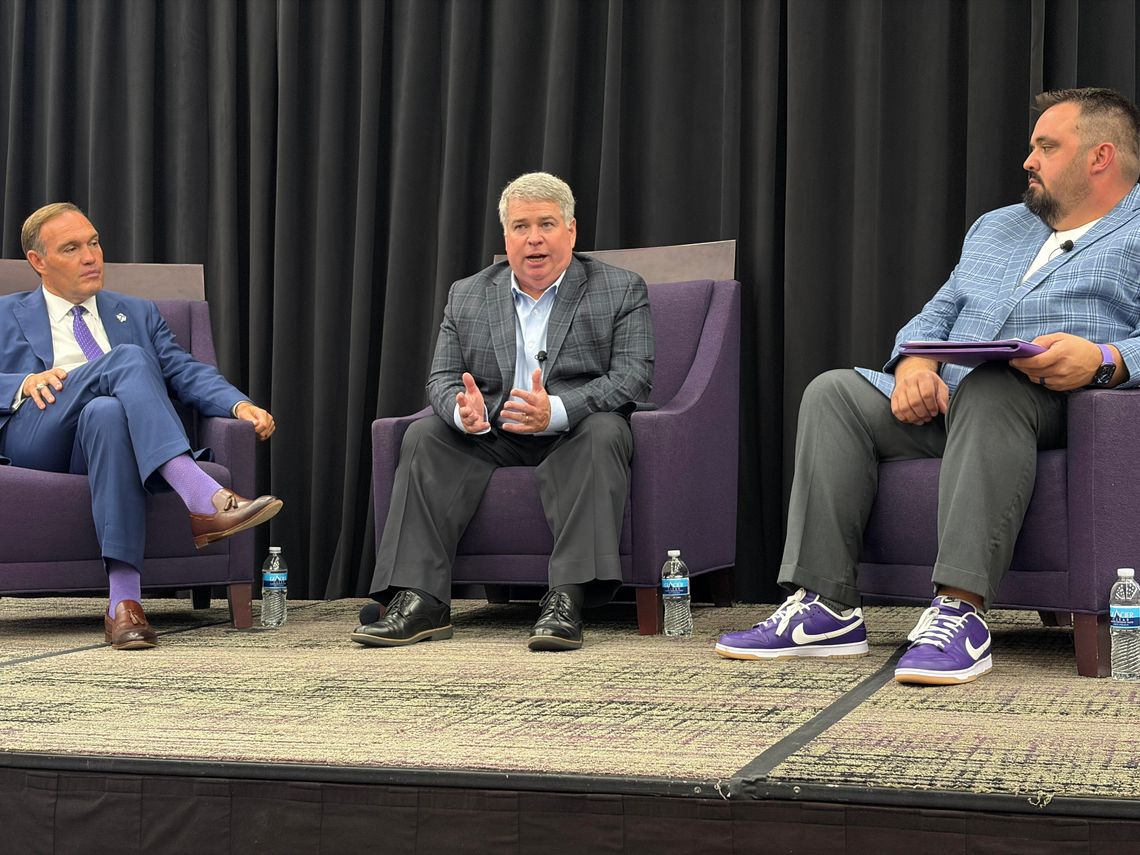
Wetzel joined Hurley and the session’s emcee, Austin Lewter, Director of the Texas Center for Community Journalism, on Aug. 28 for a fireside chat about major issues in collegiate athletics and the sports world and how his reporting has helped shape some of those conversations.
The purpose of the “Leaders & Legacy” series, according to Hurley, is to elevate the university’s academic profile by giving accomplished leaders a platform to share defining career lessons and experiences. Wetzel signing on is another example of the president finding ways to attract more exposure to the fastest-growing university in Texas.
Among those in attendance were members of the Tarleton men’s basketball team, football team, track & field team, tennis team and journalists—student and professional—from around the state. Many Tarleton students were given extra credit for showing up to the event. It worked.
A big issue addressed in the Q&A was sports gambling. Wetzel recently reported on the case of Brendan Sorsby, now former Texas Tech quarterback, who had his eligibility rescinded by the NCAA for betting thousands of dollars on his own team and professional sports while he was a backup at Cincinnati and Indiana.
In 2025, Americans spent more on sports gambling than all other forms of entertainment combined, amounting to $166 billion in wagers, according to an analysis from Fortune.
Wetzel said that while watchdogs are trying their best to keep up with the proliferation of online betting, he doesn’t think there are sufficient guardrails in place to protect the integrity of sports competition.
He mentioned former Portland Trail Blazers coach Chauncey Billups and the multiple NBA players who were arrested last October on account of illegal sports betting, meaning no one is beyond the scope of potential discipline.
“I don’t think there’s an athlete that ever goes into these competitions and says, ‘One day, I want to fix the games.’ But you find a way to get compromised, and someone’s gonna try to make a dollar on you,” Wetzel said. “So, when you are competing on anything that can be gambled on, you are a target.”
Wetzel went as far as saying that he wouldn’t recommend sports wagering at all, which got a big laugh from the audience, and himself, since he works for ESPN, which has made sports betting a huge part of its marketing.
“We’ll send that to ACU,” Hurley joked.
Wetzel also embellished the crowd with anecdotes he’s garnered over the years from covering some of the best athletes in the world.
When asked to name the most intriguing athlete he’s ever covered, Wetzel told the story of Lionel Messi, taking a page out of a book he wrote on the soccer legend in 2019 as part of his “Epic Athletes” children’s biography series.
Messi was diagnosed with Growth Hormone Deficiency (GHD) at age 11, which threatened to cap his height at five feet tall without proper medical treatment. His family couldn’t afford the treatments where he grew up in Rosario, Argentina. However, because of the soccer abilities Messi had shown at a young age, he was invited to a tryout with FC Barcelona.
“If he makes it at the tryout, he gets to Barcelona, Barcelona invests in him, they're gonna give them the medicine, he's gonna grow to 5 '7, he's gonna be the greatest soccer player of all time,” Wetzel said. “If he screws up the tryout, back to Rosario, you’ve never heard of Lionel Messi.”
Messi was just 13 at the time. He crushed the tryout. But the amount of pressure for a kid that age to overcome is what made the story worth telling.
Similarly, Wetzel had the privilege of covering Simone Biles, who he called arguably the greatest athlete he’s ever seen, in all three of her Olympic runs.
“She was the best in Rio De Janeiro in 2016; she was the best at Paris in 2024. 2021 in Tokyo, she couldn’t handle the pressure,” Wetzel said.
Wetzel covered Biles’ debilitating episode with the twisties as a columnist for Yahoo Sports. He said her story proves that no athlete is immune to any amount of pressure in any situation.
“It is still about athletes stepping up beyond what they’re necessarily capable of or maximizing out that capability,” Wetzel said. “I think that’s part of what draws everybody to the sport. We don’t necessarily know what’s going to happen.”
Wetzel had advice for students in the room who create content or one day want to cover world events like he does.
“I've done everything from Netflix documentaries, to 300 page books, to internet columns, to podcasts, TikToks,” Wetzel said. “It's all about, get it right, and then make you see it, make people understand what you're talking about ... in a simple way.
“Whether it's to get someone to watch five hours of a Netflix show or not swipe on a TikTok in three seconds, it's basically the same thing.”
As someone who learned long ago that he didn’t understand the Xs and Os of sports, Wetzel also realized that he didn’t need to in order to have a place in sports media.
The days of having to play the game to cover the game are long gone, with outlets like Barstool Sports popularizing coverage from the fan’s perspective, the rise of analytics and media companies generally being more accepting and even seeing a need for non-athletes in their coverage.
“A lot of people want to work in sports, and these days there are so many more opportunities to do that with different skillsets than in the past,” Wetzel said.
Everyone is looking for unique perspectives. Wetzel even has some himself.
Out of all the sporting events he’s covered, which includes 20 Masters, 18 Super Bowls and 10 Olympics, the most intense one of them all? The women’s free skate at the Winter Olympics.
“They all get out on this one sheet of ice,” Wetzel said, defending his case. “It's just them. No teammate, no timeout, no coach. Nothing. They got to skate around for four minutes, and they do all these twists. Everybody falls, except one, and she's the champ. Nobody can do it! It's the most intense thing I've ever seen. I'm the last person you would ever think would love women's figure skating. It is the best, man, you gotta watch this thing.”
Perhaps his most passionate answer of the session.
Comment
Comments