.png)
 Brooklyn McKinney
BY BROOKLYN MCKINNEY
Feature Editor
Christopher Nolan adapted “The Odyssey” for the 2026 big screen, an ancient Greek poem written by Homer following his other epic, “The Iliad.”
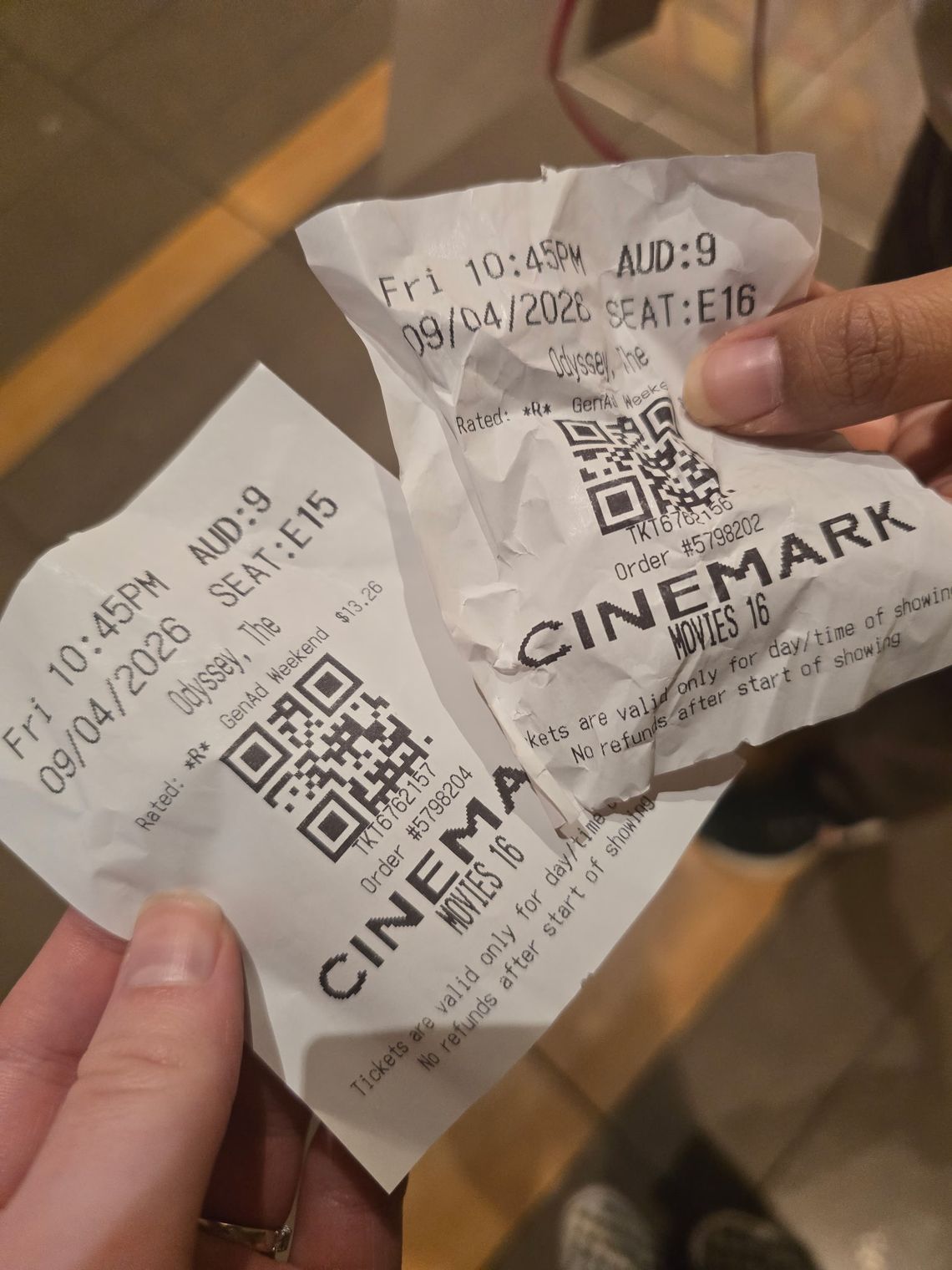
I went into the theater to see this knowing absolutely nothing. Not who was directing it, or any of the actors, or even what the Odyssey was, but I saw an ad with Greek soldiers and thought it looked pretty cool.
If you didn’t know already, “The Odyssey” is a lengthy (24 books to be exact) epic following the homecoming of Odysseus, a war general and king of Ithaca, after he is lost at sea.
The Odyssey was published after the first poem written by Greek poet Homer, the Iliad, which is inspired by the Battle of Troy when Greek soldiers infiltrated the city after a 10-year siege by crawling out of a wooden Trojan horse.
Nolan’s adaptation was released July 26 and instantly became a blockbuster hit, earning over $1.5 billion worldwide against a reported $250 million production budget. This comes as no surprise, as Nolan has previously directed box office hits like “Interstellar” and “The Dark Knight.”
As someone who has the attention span of a squirrel and went to the late-night showing running on about three hours of sleep, I can assure you I was invested for the entire three hours.
It piqued my interest enough to purchase a copy of the Odyssey and read it the next day. While I have noticed some discrepancies between the original English translations, I haven’t decided if I dislike all of them or not.
One of Nolan’s creative liberties that served the pace of the film well was incorporating flashbacks of the Trojan War along with the 10-year post-war journey home of Odysseus and his men.
Rather than beginning with a chronological sequence of events, viewers are immersed into the film with men inside Odysseus’ abandoned castle chanting a beautiful translation of a verse inspired by both “The Iliad” and the Odyssey that was written by Emily Wilson in 2017.
Although Wilson had openly criticized the film in a rather scathing review cited by The Guardian, publicly claiming that his adaptation “lacks psychological, emotional, political and ethical depth,” I would have to disagree.
What Nolan did was take an epic poem interwoven with Greek mythology and condense it into something that isn’t simply modern, but rather an idealized version of a character in a fantasy setting.
While the original Odysseus was a ruthless war general, pillaging and conquering towns and cheating on his wife, Nolan’s Odysseus is presented as a noble soldier and a devoted husband.
Additionally, rather than the goddess Athena being a tangible form, she comes to Odysseus with wisdom as a godlike figure that only he seems to be able to see and hear. Many spiritual themes seem to remain present throughout the film.
After a hard decision that cost Odysseus’ army the lives of seven men, some soldiers come against him, only for Odysseus to claim that he “had every right” to pay the price if it would spare the rest of their lives.
One of the main themes running throughout “The Odyssey” is suffering in relation to higher powers, or the Greek gods. In arrogance and pride, Odysseus initially makes many bad calls that anger the gods and prolong his journey home in both the original poetry and Nolan’s adaptation.
Nolan doesn’t exactly hide Odysseus’ flaws but rather redeems him as a hero upon his homecoming.
For example, a witch that the lost soldiers come into contact with is also reimagined as a traumatized woman rather than a villain, who is eventually convinced by Odysseus to lift the curse she had placed on his men.
This character development throughout the film made the scene of Odysseus accepting his wife’s challenge and brutally fighting the suitors who had invaded his castle along with his son, Telemachus, that much more rewarding.
Additionally, the cinematography was not only beautiful but terrifying enough during scenes of battle for my horror movie fanatic friend to slightly jump in her seat.
The only complaints I have are more directed at Hollywood casting in general. There were many household names in this movie, like Anne Hathaway, Tom Holland, Robert Pattinson, Zendaya, Charlize Theron, and, of course, Matt Damon as Odysseus.
Their performances were expectedly great. However, I think Tom Holland seemed to be about the only person in the movie who hadn’t had some kind of work done. While it is a fantasy, it’s rather disorienting to see a bunch of Botox in what is supposed to be ancient Greece.
I mean, Botox is basically like having a disability for actors because it makes their faces way less expressive. I know social media has made people afraid of aging, but those lines exist for a reason.
I also miss when historical fiction cast women with softer and delicate features that aligned more closely with the beauty ideals of previous time periods, but now everyone seems to look like they came straight off of the Instagram profile of an influencer.
Overall, all three hours of this movie were an entertaining experience that had me thinking about the bigger picture behind the spiritual realm and suffering on Earth long after the credits rolled.
My only complaints seem rather shallow in comparison, and I’m sure this reimagining of “The Odyssey” will inspire many others to pick up the original poem.
Comment
Comments