
 Kellan Byars
BY KELLAN BYARS
Digital Media Director
At some point in every student's education, someone says the same boring thing: “You need to study.”
It might come from a high school teacher when talking about test prep. It might come from a college professor reminding the class that the upcoming exam covers everything from the semester. It might even come from a parent who sees a student sitting at the kitchen table with a textbook open and asks, “Have you studied yet?”
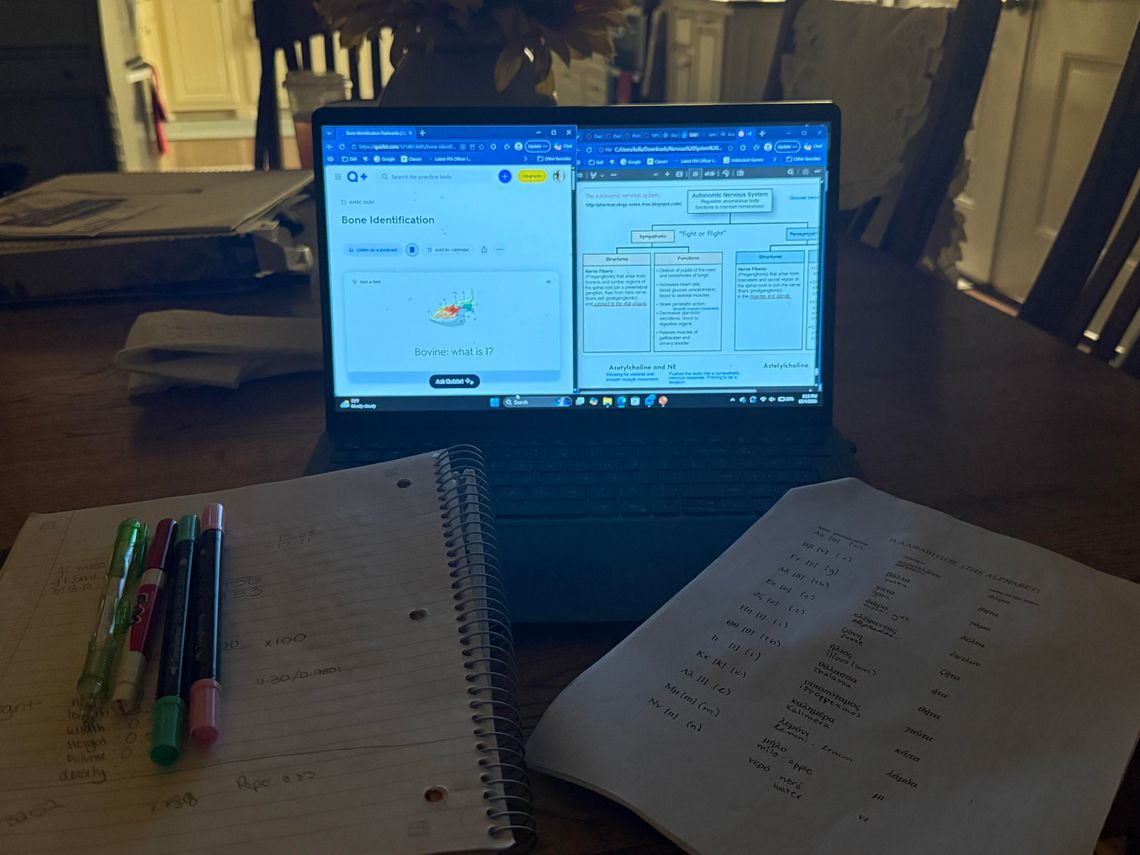
The expectation that students should study is well understood, but the instructions on what studying should actually look like are not.
For many students, studying means re-reading notes, highlighting textbook pages, making flashcards or staring at a study guide until their eyes water. Others wait until the night before an exam and cram to learn an entire unit in a few hours. Some spend hours at their desks and still walk into an exam wondering why they can’t remember what they studied.
The problem may not be that students aren't trying hard enough. It may be that no one ever taught them what effective studying actually looks like.
Research on learning has identified several strategies that can help students retain information and perform better academically. Practice testing, for example, is one of the more effective study techniques, while spreading studying across multiple sessions can improve long-term retention.
However, students simply knowing that they should use a specific method is not enough. They need to know what those strategies look like when they sit down at their desk.
Studying is not one-size-fits-all
No single study method is going to work the same for every class. A student studying anatomy may need to see and label a diagram. Someone studying chemistry may need to repeatedly work practice problems. A student preparing for a history exam may need to organize dates and events into a timeline.
Even within the same class, different techniques help students understand different types of information.
Also, no one has to understand their learning style (visual or hands-on) to determine how to study best. What has been more beneficial for a lot of students is building a study toolbox and choosing the method that best fits the material they are trying to learn.
Flashcards: Learning in stages
For classes with a lot of vocabulary, formulas or specific facts, flashcards can be one of the easiest places to start. The important part is how they are used.
Flashcards should not simply become a way to re-read information. Students should look at the question or term on the front, try to recall the answer before flipping the card and then check whether they were correct.
Flashcards are especially useful when a class requires students to know a large number of specific details. They can also make it easier to repeatedly retrieve information over several days rather than attempting to memorize everything in one sitting.
However, flashcards aren't necessarily the best tool for every subject. Memorizing a definition is different from understanding how an entire process works. For bigger concepts, another method may work better.
Concept maps: Seeing the whole picture
When information feels like a collection of disconnected facts, concept maps can help students see how everything fits together. Instead of writing information in a traditional list, students can start with a central idea and branch outward.
For example, someone studying animal reproduction might put “Reproductive Cycle” in the center of the paper. From there, they could branch into the extra sections and details connecting related concepts along the way. The process encourages thought about relationships instead of simply copying information.
Concept maps can be particularly useful when a test asks students to explain a process or understand how multiple concepts interact. Concept maps also give students something that a stack of notes does not: a visual representation of the big picture instead of all the details at one time.
Grab sheets and fact sheets: Create your own study guide
One of the most useful tools for a student taking a cumulative class may be something as simple as a grab sheet, sometimes called a fact sheet. The idea is to create one condensed document containing the most important information from a unit, chapter or course.
A student might include major ideas, important dates or processes and things that are typically forgotten. The goal is to condense information, rather than copy an entire set of notes.
A fact sheet can also become more valuable as the semester continues. Instead of starting from scratch when a cumulative final approaches, students can have a collection of condensed sheets from each unit that can be reviewed together.
For a student taking a course that builds on itself, those sheets can even become a useful resource later in their academic career.
Teach someone else (The “Can I actually explain this?” test)
One of the easiest ways to find out whether you actually understand something is to try to teach it to someone else.
Students can explain a concept to a roommate, parent, friend or even an imaginary audience. The important part is to explain the idea without just reading from the notes.
Teaching turns studying into a test of understanding.
Brain dump: Put the notes away
A brain dump is another simple form of retrieval practice. Instead of looking at notes and trying to determine whether the information looks familiar, students put everything away and write down everything they can remember about a topic.
No textbook. No notes. No study guide. Just a blank sheet of paper.
For example, after studying the skeletal system, a student can write every bone, structure and fact they can remember. Once they are finished, they can compare their brain dump with their notes and see what they forgot. The missing information becomes the focus of the next study session.
Retrieval practice requires students to pull information out of memory, which is one reason it can be more useful than simply reading over notes. It’s a great way for students to get immediate feedback about what they actually know.
Make your own test
If the professor is going to make a test, students ought to make their own test first.
Creating your own test forces students to think about the material from the perspective of the person writing the questions.
Students can create a combination of:
- Multiple-choice questions
- Open-ended questions
- Definition questions
- Process questions
- “Explain why” questions
- Application questions
- Detailed questions about small pieces of information
Students sometimes study only the major concepts because they assume the details won't matter. Creating their own test encourages them to consider both the big picture and the finer details.
Once they write the test, students should take it without looking at their notes. And when they miss a question, they have identified exactly what needs more study time.
This combines two useful study strategies: creating questions, which requires students to work with the information, and answering those questions, which requires them to retrieve it.
The best study method may be a combination
Each study method is effective by itself, but ultimately, the best study process comes from using a combination of these methods.
For example, a student preparing for an anatomy exam might:
1. Create a fact sheet for each unit.
2. Draw and label important structures.
3. Use flashcards for vocabulary.
4. Complete a brain dump without notes.
5. Teach a difficult process to a friend.
6. Finish by taking a self-created practice test.
Again, that’s so much better than reading a textbook for hours. It illustrates the number one takeaway of effective studying: Students should spend time actively working with information rather than simply looking at it.
Oftentimes, the best studying comes from outside the textbook. Draw a diagram, teach a friend, make flashcards, build a concept map, create a test of your own or study for 30 minutes at a time throughout the week instead of staring at notes for five hours the night before an exam.
Most importantly, don’t think about studying “harder.” Study smarter.
Comment
Comments