
 Hannah Brooks
BY HANNAH BROOKS
Marketing Director
Since Tarleton State University was founded in 1899 as John Tarleton Agricultural College, its students have coexisted with World War I, World War II, the wars in Korea, Vietnam and Iraq. Some came home with the nation's highest military decorations. Others did not come home at all.
Many students throughout Tarleton’s history enrolled expecting the ordinary college experience. They had friends, classes, extracurricular activities and plans for a career. But then, they were called into action by their country.
Suddenly, the future they imagined became very different. Many students enlisted in the military and those who remained on campus experienced a university and a country transformed by wartime demands.
The six veterans profiled here are a small, select group, chosen because their records are well documented and, in most cases, decorated. This is not a ranking of Tarleton's bravest soldiers. They represent only a fraction of those who served.
According to “Tarleton Landmarks” by Frank Chamberlain, in Tarleton’s Libraries, more than 2,500 former students served in World War II alone, and 178 of them died.
(A 2018 university news release put the number of faculty, staff and students lost in WWII at 179, the counts varying by source. Comparable figures for other conflicts were not readily available.)
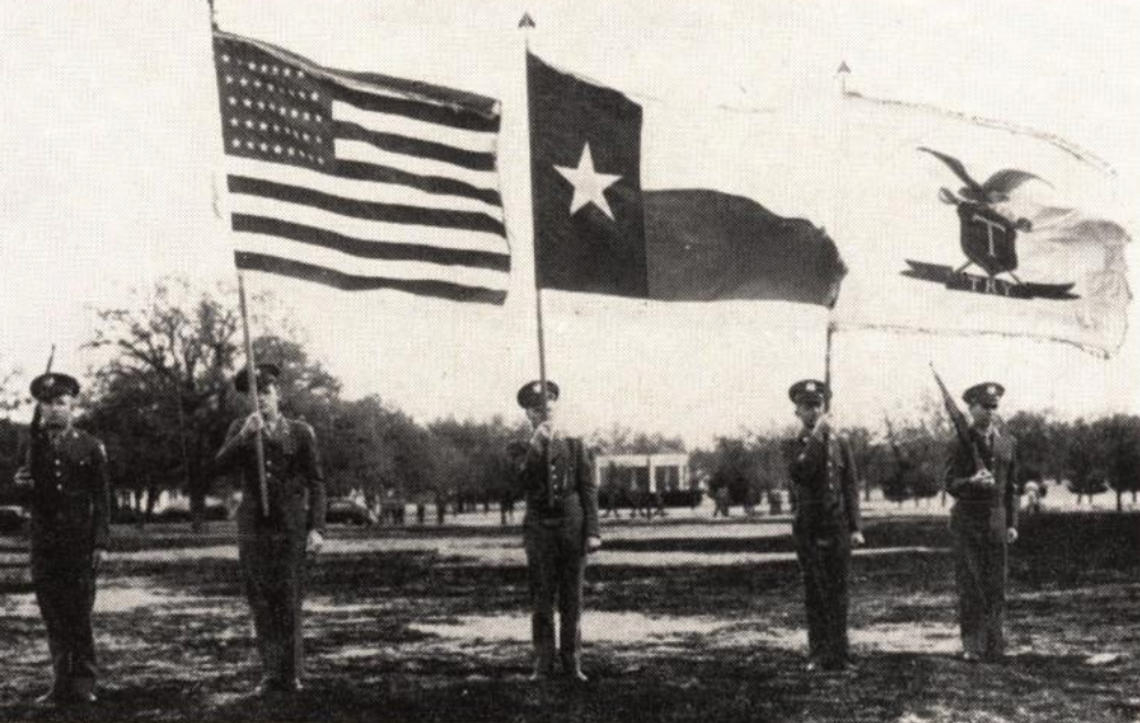
Military life has long been part of the campus. Military training began in 1917, the year Tarleton joined the Texas A&M University System, and a permanent ROTC program likely took hold by 1921, according to Chamberlain. Tarleton's Corps of Cadets was reactivated in 2016.
WWI
- Ammon Turnbow - Marine Corps
Pvt. Ammon Turnbow had been a student at John Tarleton College before he was killed by a German machine gun on Nov. 1, 1918, during the Meuse-Argonne Offensive, the last major battle of World War I. He was a Marine and died 10 days before the Armistice.
According to Tarleton records, he was the first Erath County resident to die in the war. A Stephenville American Legion post still carries his name.
WWII
World War II reshaped Tarleton and emptied her campus. Enrollment fell from 1,266 students in 1940 to 332 in 1943, according to Chamberlain. Many would-be students were drafted or volunteered, while others took jobs in defense plants or businesses short on workers.
The Dean at the time, J. Thomas Davis, stretched the summer term into a full 16-week semester so students could graduate sooner and join the war effort more quickly. 22 faculty members left to serve, and two did not return. The class of 1943 sponsored a granite memorial in front of the E.J. Howell Building to honor the Tarleton community members who served.
Two of the war's best-known Stephenville men came from that era.
- William "Ed" Dyess - Army
Lt. Col. William Edwin "Ed" Dyess grew up in Albany, Texas, and arrived at Tarleton in 1934. He studied pre-law, ran track and commanded the school's ROTC detachment before finishing in 1936, according to the Texas Legislature and university records. He joined the Army Air Corps in 1937.
As commander of the 21st Pursuit Squadron in the Philippines, Dyess refused to abandon squadron members who could not be evacuated when the Bataan Peninsula fell to Japanese forces in 1942, according to biographical accounts.
He survived the Bataan Death March and escaped captivity in 1943. Gen. Douglas MacArthur personally presented him a second Distinguished Service Cross in the form of an oak leaf cluster on July 30, 1943. Dyess' account of the ordeal was published in 1944 as "The Dyess Story" and became a best-seller.
Dyess died in a plane crash in California on Dec. 22, 1943. He was 27. His other honors include the Silver Star, the Legion of Merit and the Distinguished Flying Cross. Dyess Air Force Base in Abilene is named in his honor.
In 2015, Texas posthumously awarded Dyess the Texas Legislative Medal of Honor, and in 2016 he was part of the inaugural class of the U.S. Army ROTC National Hall of Fame.
- James Earl Rudder - Army
James Earl Rudder, who rose to major general, spent three years at Tarleton beginning in 1927 before transferring to Texas A&M. He returned in the late 1930s to teach and coach football.
On D-Day, June 6, 1944, then Lt. Col. Rudder led the 2nd Ranger Battalion up the 100-foot cliffs at Pointe du Hoc in Normandy under enemy fire to destroy German gun positions. More than half the battalion became casualties, and Rudder was wounded twice, according to a Texas Legislature resolution.
He later commanded the 109th Infantry Regiment in the Battle of the Bulge. His decorations include the Distinguished Service Cross, Silver Star, Legion of Merit, Bronze Star and Purple Heart.
After the war, Rudder became president of Texas A&M University and later of the entire A&M System. He died in 1970. The main walkway on Tarleton's campus, Rudder Way, bears his name.
Korea
- Joe R. Long - Army
Joe R. Long enrolled at John Tarleton Agricultural College in 1947 and earned his certificate in 1949, then transferred to the University of Texas at Austin, where he was an ROTC cadet.
After graduating in 1951, Long was called into service during the Korean War.
Long returned to Texas to be a high school teacher in Alice, where he met his wife, Teresa Lozano. He went on to practice banking, insurance and securities law, helped organize two Austin banks and served as chairman and CEO of First State Bank until 1998.
The couple became major philanthropists, and Tarleton awarded them honorary doctorates in 2012. Long passed away on Oct. 7, 2026, at age 96.
Vietnam
- Lacy Breckenridge - Air Force
Col. Lacy Breckenridge graduated from Tarleton in 1950, then attended Texas A&M and became a fighter pilot. When the Vietnam War began, he was among the first to enter the fight, according to Tarleton records.
On his 49th mission over North Vietnam, enemy fire hit his aircraft and forced him to bail out over hostile territory. He landed in a tree and stayed hidden for three hours before an Air Force helicopter rescued him.
Breckenridge flew 100 combat missions in all and received the Silver Star and Distinguished Flying Cross for bravery in combat. After retiring from the Air Force, he became an executive pilot and businessman.
Tarleton named Breckenridge its Distinguished Alumnus in 2019.
Iraq
- Chris Kyle - Navy
Chris Kyle spent two years at Tarleton, from 1992 to 1994, studying ranch and range management before leaving to work as a ranch hand. He joined the Navy in 1999 and became a Navy SEAL sniper assigned to SEAL Team 3. He served four tours in Iraq before retiring as a chief petty officer in 2009.
His 2012 autobiography, "American Sniper," became a bestseller and was adapted into a film. Kyle died on Feb. 2, 2013, at age 38, as one of the most prolific snipers in U.S. military history. Tarleton honored him that year as its Outstanding Young Alumnus, and in 2015, he was posthumously awarded the Texas Legislative Medal of Honor.
Kyle’s medal count has been a point of dispute. A 2015 Tarleton news release and Kyle's own book cite two Silver Stars and five Bronze Stars. However, after reviewing his records in 2016, the Navy revised that figure to one Silver Star and four Bronze Stars with valor devices.
Still serving today
Tarleton's military identity has re-emerged in recent years. The Texan Corps of Cadets returned in 2016, and the university has stated that it aims to be designated as a Senior Military College.
On the east end of campus, a 1902-model cannon sits in front of the E.J. Howell Building. It was brought to campus in 1922 for ROTC training and fired at celebrations until World War II, when it was sealed. It has not fired since. A granite memorial to those who served stands a few steps away.
Comment
Comments