.png)
BY KELLI MCKEE
Contributing Writer
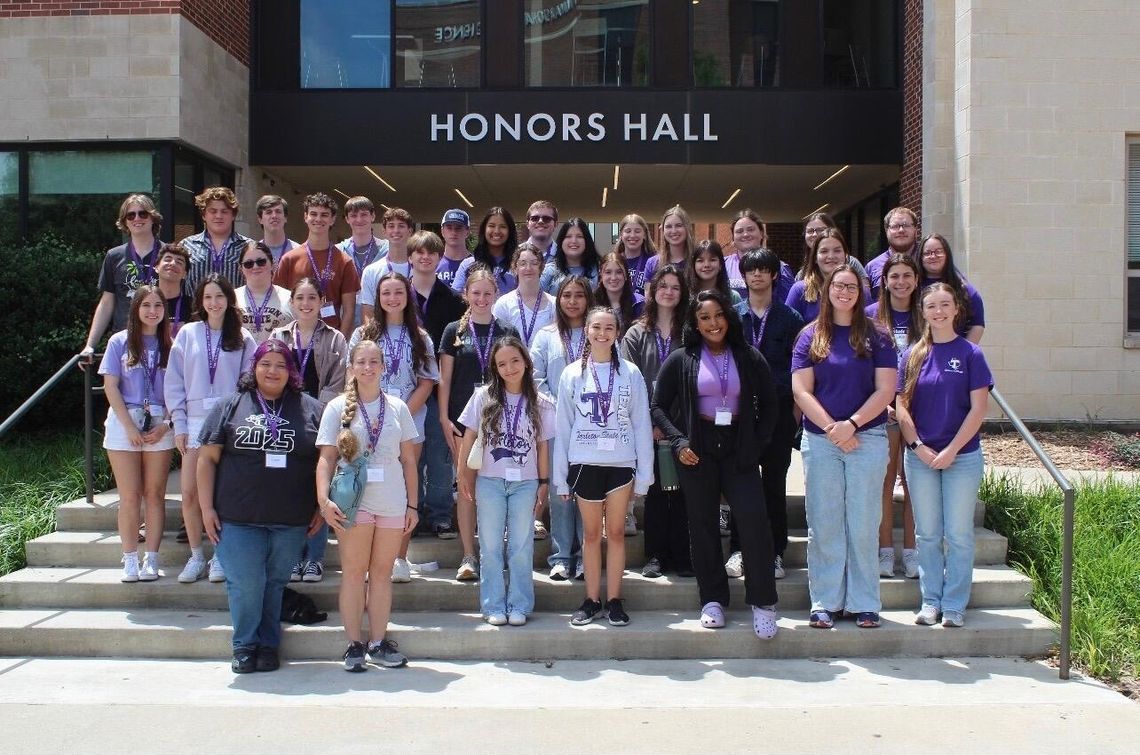
Close mentorships, smaller class sizes, research opportunities and discussion-based classes are just a few of the many benefits students get from the Honors College program at Tarleton.
Sarah Franz Petry, the administrative coordinator of the Honors College, gives a deep explanation about what the Honors College strives to create.
“The purpose of the honors college is to create a like-minded academic community,” Petry said, “where we value education, high-achieving environments and strive for excellence.”
The honors program at Tarleton State University continuously enhances the academic experience for high-performing students by creating a tight-knit community, having smaller class sizes, offering ample research opportunities and forming close relationships with mentors as well as professors.
Tarleton sets challenging admission requirements for each student or applicant to fulfill. The applicants must meet at least one of the following criteria: be in the top 25% of their high school graduating class, earn a minimum SAT score of 1130, earn a minimum ACT composite score of 24 and have a minimum unweighted GPA of 3.5 on a 4.0 scale.
Students strive to stay within the requirements throughout the semester, which includes maintaining at least a 3.0 cumulative GPA, being enrolled in at least one honors core course or having completed an honors contract each semester until a minimum of 18 hours have been completed.
An honors contract is an advanced academic agreement between the Honors College, faculty and students that allows students to participate in independent study or research projects that pertain to whatever the student wants. This is primarily for students who seek additional opportunities within their chosen field. This allows students to build stronger academic portfolios while also getting to work closely with faculty mentors.
Students also have the opportunity to apply for a spot in the Presidential Honors Program. These students are held to higher academic standards, and only approximately 20 students will make it.
To apply, students must be in the top 10% of their high school graduating class, score a minimum of 1260 on their SAT, score a minimum of 27 on their ACT, be scored on the quality of their essays, include their involvement in extracurricular activities, partake in services to the school and the community, include three references and participate in an on-campus interview (finalist only).
Students strive to stay within the presidential honors program as well, which includes maintaining at least a 3.4 cumulative GPA, having completed a minimum of 12 hours of academic courses every semester, completing honors courses, seminars and thesis. Students are also expected to show service and leadership to the community. This could include joining campus organizations or volunteering for community opportunities.
One defining feature of the Honors College is the smaller class sizes. These are discussion-based classes that focus on active learning. These classes create closer relationships with students and professors and allow students to be more engaged throughout the lectures.
“We know statistically smaller class sizes are better for learning,” Dr. Karl Aho, associate dean of the Honors College, said. “But more importantly, the smaller class sizes help to enable that sort of intellectual community.”
Julia O’Neal is an honors student at Tarleton that shows strong academic achievements and great leadership.
“Being a part of the Honors College has made me a much better person,” O’Neal said. “It has pushed me to be a better version of myself; it also makes me more motivated and has given me a community that supports that.”
The Honors College is a program that continues to help students succeed inside and outside of the classroom. The support and commitment to excellence that the Honors College portrays helps students dive deeper and go beyond the standard curriculum.
“The Honors College is full of intellectual opportunities and social opportunities, “Aho said. “If I had one phrase to define the Honors College, I would say intellectual community.”
Comment
Comments