.png)
 Kellan Byars
BY KELLAN BYARS
Multimedia Journalist
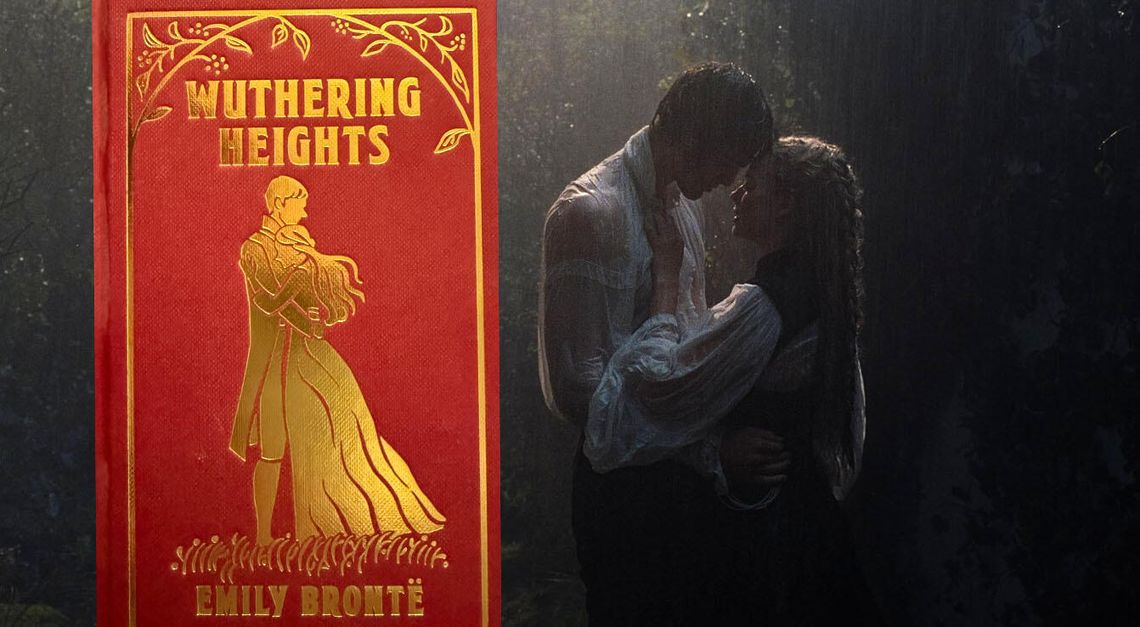
Few novels feel as emotionally violent and all-consuming as “Wuthering Heights.” Published in 1847 by Emily Brontë, the novel has long stood as one of the most haunting works of Gothic literature.
It's not a gentle love story but a portrait of obsession, pride and generational damage set against the unforgiving Yorkshire Moors.
This year’s film adaptation, produced by Emerald Fennell, starring Margot Robbie and Jacob Elordi, does not betray the novel so much as reinterpret it.
While the film preserves the skeleton of Catherine and Heathcliff’s story, its reinterpretation shows how differently a 19th-century gothic novel can exist in a 21st-century medium.
One of the most striking differences is Fennell’s decision to only adapt the first half of the novel. Brontë’s original tale bleeds into two generations, using the second half of the book to show the consequences of Heathcliff’s obsession and the eventual collapse of his plot for revenge.
The film, however, closes its focus around Catherine and Heathcliff’s doomed love, ending before the younger generation is able to change the narrative.
This is not necessarily a flaw; it creates a tighter, more emotionally concentrated story, but it does fundamentally shift the narrative from one about trauma cycles to another about tragic romance.
The novel lingers in the aftermath; the film ends in intensity.
Another critical difference is the choice to change Heathcliff’s race. In the novel, Heathcliff is described as having dark skin and appearing racially ambiguous.
At some point, Mr. Linton even refers to him as "a little Lascar, or an American or Spanish castaway.” The term “Lascar" typically referred to Indian or Southeast Asian sailors.
His race shapes how he is treated, why he is degraded and how he becomes alienated in the unfair class structure of 19th-century England.
By casting a white actor in the role, the film strips away an important layer of his outcast identity.
His suffering becomes framed almost entirely as romantic heartbreak rather than racialized exclusion and marginalization.
While adaptations inevitably reinterpret characters, altering Heathcliff’s racial identity softens the novel’s commentary on prejudice and belonging.
In a story so deeply rooted in themes of social cruelty, that shift is not just surface-level, it changes the moral guidelines of the narrative.
The adaptation also chooses to leave Hindley Earnshaw, Cathy’s brother, out of the picture. Hindley is an important part of the novel, as he contributes greatly to the reason Heathcliff turns into the vengeful character he becomes.
Hindley’s treatment of Heathcliff, reducing him from adopted brother to servant, is one of the first cruel acts in the novel.
The film chooses to portray Heathcliff as an anti-hero who is filled with hatred toward the world because of romantic heartbreak, rather than a complex character who is filled with hatred because of the way he was treated as a child.
One of the most dramatic shifts, however, lies in the way intimacy was expressed between characters.
In the novel, Catherine and Heathcliff’s love is obsessive, spiritual and destructive but not overtly physical. In fact, they share only one kiss, and it occurs on Catherine’s deathbed.
Their relationship is defined more by emotional connection and strain than sexual expression.
The film, by contrast, transforms their connection into a full-fledged affair with heightened physicality not seen in the novel.
This oversexualization makes their love seem passionate and consumable, rather than suffocating and corrosive.
Cathy and Heathcliff are not a love story; they are toxic and not good for each other. Where the novel centers on trauma, pride and revenge, the film leans into sensuality.
The result is more cinematic, but arguably less psychologically disturbing.
Even the setting experiences reinterpretation. In Brontë’s writing, the Yorkshire Moors are not simply a backdrop; they are a character in their own right. The wild landscape mirrors the volatility of the main characters.
In the film, the moors are undeniably beautiful. The cinematography captures golden light and vast horizons that really reflect the emotion of the story.
Visually, it is stunning. Yet the landscape functions more as an aesthetic background than an active force.
The moors frame the romance; in the novel, they’re part of it.
That said, the film’s visual achievements cannot be understated. The costume design, lighting and composition transform the adaptation into something undeniably captivating.
There is intent behind every shadow and softness behind every close-up. The visual storytelling was intoxicating and filled with beauty.
While the book explores an inner world and the unreliable narrator, the film achieves a sense of longing through the use of silence and visuals. It might simplify the narrative, but it adds depth to the experience.
Ultimately, this adaptation does not replace Brontë’s vision but refracts it. The film transforms a generational gothic tragedy into a concentrated romantic drama. Where it’s missing aspects of the original story, the film makes up for it in beauty.
Nearly two centuries after its publication, “Wuthering Heights” continues to prove its adaptability. The story survives reinterpretation because its emotional core overflows with addictive obsession and tragic longing.
Comment
Comments