.png)
 Gavin Patrick
BY GAVIN PATRICK
Sports Editor
“People will forget what you said, people will forget what you did, but people will never forget how you made them feel.”
It’s a quote from the late American poet Maya Angelou.
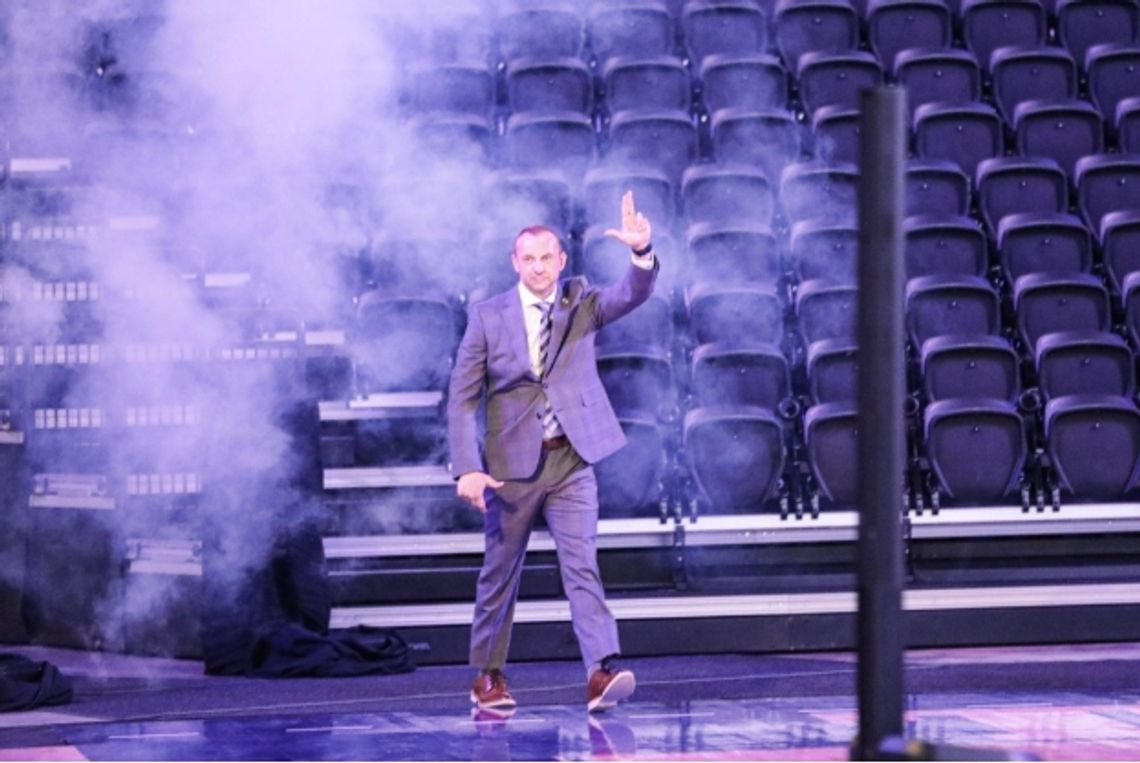
It’s also someone else’s self-proclaimed “code” as a human being. That person — by coincidence or not — is now Tarleton State’s men’s basketball coach.
Life has come fast at Eric Haut. Just over a month ago, he was coaching Utah State to a first-round win in the NCAA Tournament, while working a second job trying to get his staff and roster together at Tarleton State University.
Now, over a month into the new job, all that sits in Haut’s office, still, are a couple of water bottles, a container of Clorox wipes, some unpacked boxes and a flat-screen TV.
“I’m not even in the move-in process yet,” Haut said. “My wife and my son went back to Utah from the Final Four, so she’s packing up. They’ve got me in some temporary housing.”
“I literally have the same clothes that I packed for the NCAA Tournament; that’s the same suitcase that I’m living out of right now. Because I never went back [to Utah].”
All of that — and still, no one has embraced their platform more in that time than Coach E.
Since rebranding himself as Tarleton State’s men’s basketball coach, Haut has been very active on social media. From spontaneous video messages, to a Q&A session, to showing his presence at a number of university events, Haut is choosing to integrate with the community — and faster than most people would expect.
“It’s the only way I know how to be,” Haut said. “I've always been very engaging wherever I've been in the community, on campus. It's just, people want to feel a connection, right?”
He views his coaching the same way.
“I can't get our players to their maximum potential if I don't have relationships with them. I just can't,” he said.
Haut learned the art of developing rapport with players from his former boss at Utah State, Jerrod Calhoun, who recently accepted the head job at Cincinnati.
“That was kind of like our secret sauce at Utah State. We were never the most talented team in our league… but we were the most connected team in the league. We were the best team in the league,” Haut said.
In his opening press conference, Haut went as far as declaring that he and his staff will lead the country in time spent with their players. And he has a plan, starting with what he calls the foundation of his program: player development.
“I'm going to be working guys out individually, along with the rest of our staff,” Haut said. “I'm going to be doing a lot of individual film sessions with different positional groups; I'm going to have daily and weekly touch points with all of our players.”
Those responsibilities are usually pawned off, in his words, to assistant coaches. But Haut will be very hands-on.
His plans off the court, though, are where the connections will really be shaped.
“We may have a leadership council, where three or four guys are in that and we're reading a book about leadership over the summer,” Haut said. “That could mean, I'm gonna grab so-and-so and we're gonna go to Buffalo Wild Wings and have lunch. … That could be, I'm going to have three or four guys over to my house to have dinner one night with my wife and [son] Karter.”
Haut views his players as a part of his family. They’re a huge priority in his life.
In fact, in his eyes, every player’s family should be embraced as an extension of the team. He has a plan to welcome them, too.
“We'll have a parent group, where it's a group text with all our parents on it so that they can be connected,” Haut said. “We're gonna have parent meals. We'll pick three or four [home] games a year where this is a family day; so after the game, we'll have a meal catered in for our parents and our significant others and their children and their siblings so that we can build that connection.”
Guess what: it doesn’t stop there.
Haut wants to broaden that web of connection to the entire community. To him, this means putting more time into community service than any other team in the university—and showing up to support those other teams at their games.
“I want our players to be well known in the community… I want to share in everyone's success,” Haut said. “So, that's really important for our program and for our guys to, again, understand you're a part of something bigger than yourselves.
“To me, that stuff, that leads to wins,” he continued. “Maybe not in the win-loss column — I think it does — but just in life in general. I just think that's important, man.”
Haut may be a good quote. But with only three losing seasons in 22 years as an NCAA coach (all of which came at TCU from 2008-11), six appearances in the NCAA Tournament and fresh off contributing to a record-setting season at Utah State, he has the cachet to say… it’s working.
And despite inheriting a team coming off two straight losing seasons, Haut was not shy about his goals for the Texans’ next season.
To remind himself of these goals, Haut will soon be making another addition to his bare office: a piece of net he cut down after Utah State’s win in the Mountain West conference championship on March 14.
The net will be in his line of sight every day — because a year from now, he plans to add to the collection with a fresh piece of net from the UAC Championship.
“I've always set ambitious goals,” Haut said. “Nobody thought I could be a Division I player; I ended up being a Division I player. Nobody thought I'd be an all-conference player; I was an all-conference player. I don't think anybody knew what my path would be in terms of coaching, but I feel like I've always just set high expectations and worked my butt off to get there. And I feel like this is no different.”
How will he get Tarleton State to the mountaintop? Again, it all comes back to player development.
Tarleton State may not be the most talented team in the UAC this year. Neither was Utah State in their conference. So when players inevitably make mistakes, or don’t come up with the right results, Haut wants to remind them to be “process-oriented.”
Take, for example, the way a player shoots a basketball.
“When you're working on your shooting, guys will get caught up in if they made it or missed it. But you can shoot a shot the wrong way and make it, and you can shoot a shot the right way and miss it,” Haut said. “So if you get caught up in the makes and misses, it's really not best for your development. You want to shoot the right shot the right way.”
Haut has a system he’ll implement to reward players for doing things the right way. They’re called accountability charts, one for offense and one for defense.
Players will be graded every day in practice on how well they apply certain concepts the coaching staff wants to emphasize. For instance, if a player makes a great pass but their teammate misses the shot, the former will still be graded positively.
“It's process over outcome,” Haut said. “If you embrace the process and you believe in the process, the outcomes that you want, they will come.”
What the “process” really means, to Haut and his staff, is having championship habits every day. Part of that is to not let their players get down about the results maybe not coming as fast as they want.
“We coach with a lot of positivity. Even when we have to push guys, it's always because we know how good they can be,” Haut said. “... I'm high care, high accountability. And that's where the relationship piece comes in.
“I cannot maximize someone's potential if we don't have a relationship,” he continued. “‘Cause at some point, I'm gonna have to push them further than they think they can go. And if they know I have their best interests at heart and I'm really trying to get them to where I feel like they can get as a young man and as a player, they're gonna be more open to that coaching.”
Another area Haut wants the program to shine in is efficiency.
“I've been a part of staffs and workplaces where you'd meet for five hours, and you could have got that meeting done in about 45 minutes,” he said.
That’s why Haut said he wants to keep film sessions to about 15 minutes. He may even show film on the court some days with a portable TV, he said, so then after about five clips, players can get up and start applying the lessons immediately.
“Our practice plan will be down to the minute. We'll know exactly when we're transitioning to the next thing,” Haut said. “We will jog to the next thing; we're not walking around. Everything will be very, very efficient in everything we do.”
To this point, Haut has more goals set for the program than he has items in his office.
Never mind the program structure and accountability, he’s set tangible goals as well, like being top 50 nationwide in assists, top 30 in tempo, top 20 in steal percentage and top three in offensive and defensive efficiency.
Besides steal percentage, the team wasn’t close to any of those marks last year. But that doesn’t matter to Haut.
“This is a new era, this is a new energy, and we're just moving forward,” he said.
Haut’s approach may be a little different than most. It’s certainly a significant deviation from the previous regime. But even if his vision takes some time to come into focus, he won’t blink.
“I'm not saying it's better or worse. Just different,” Haut said. “It’s gonna be a different way of doing things.
He just has to be him, he said. It’s the only way he knows.
“We're gonna win in everything we do. We're gonna win in the weight room; we're gonna win in our recovery; we're gonna win in the community; we're gonna win in the classroom; we're gonna win on the court,” Haut said. “I just feel like it's a mindset, and right now, we are building that mindset.”
There are a lot of factors that will play into Haut’s goals being realized — some of them uncontrollable. For instance, another goal he has is to double the home attendance record of 3,187 in year one. Ambitious.
But there’s one thing Coach E knows to be true:
“When people feel a connection to something, they're more apt to support it.”
And it’s on to 2026.
Comment
Comments