.png)
 Andrew Utterback
BY ANDREW UTTERBACK
News Editor / Podcast Producer
“Guys, it’s sumo wrestling!”
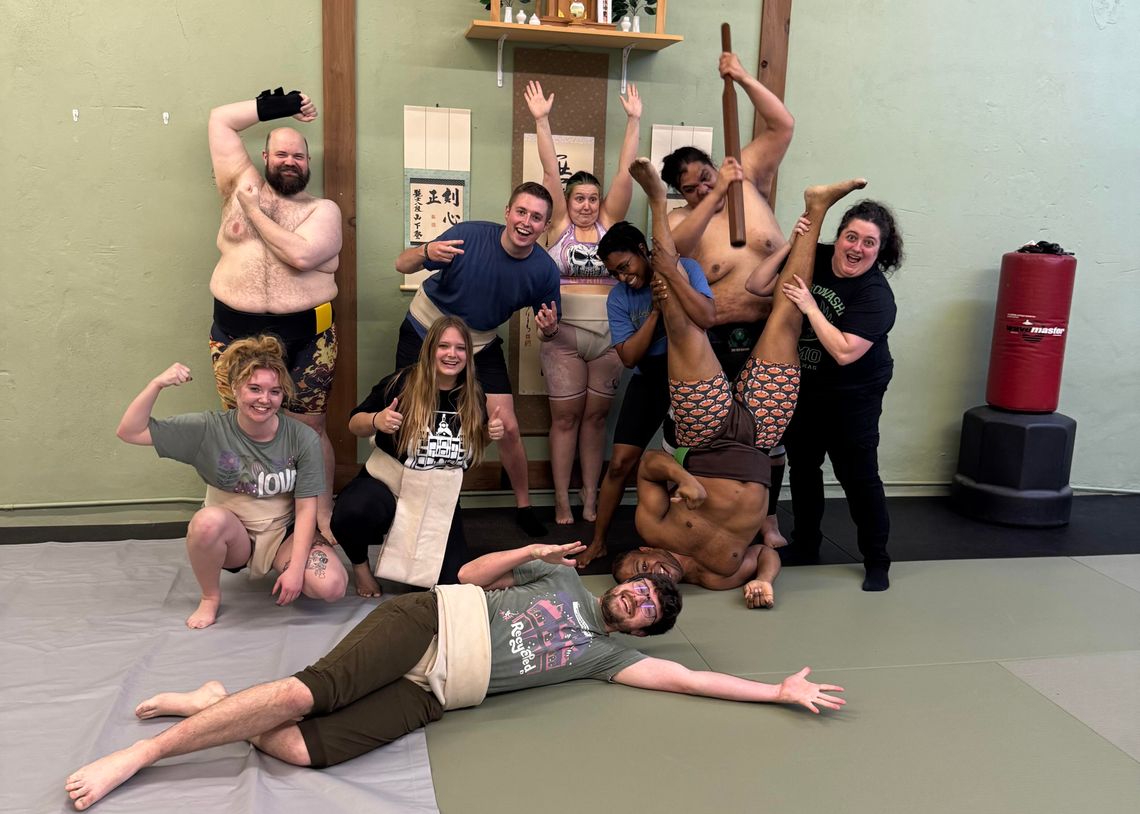
I shouted that with excitement to my group of TNS staffers as I looked through a storefront window. We were strolling through Denton’s Town Square after a day of sessions at the Texas Intercollegiate Press Association (TIPA) when we stumbled across the captivating glow of sumo wrestling coming from Kurowashi Sumo Collective at The Dojo.
We had just wrapped up boulder climbing at Movement, a gym just down the street, and were heading to dinner when we collectively decided to stop and check out the wrestling.
Upon entering the dojo and receiving a warm welcome from everyone, we were directed to sit in the viewing area and watch the wrestlers warm up. After 15 minutes or so of spectating, our staff was asked if we wanted to participate in the warmups.
We said yes about as fast as one can, and walked onto the mat. We started with fairly regular stretches and eventually learned how to perform several sumo rituals. Shiko was the first we were taught and is likely the most iconic of them all. It’s essentially a foot stomping exercise, that both warms up the wrestlers and is meant to symbolize stomping out evil spirits. The Chirichozu ritual was next, and for this one, we were all in the ring. We got down into the sumo resting position and clapped once, then raised our hands to show we had no weapons and intended to have a clean fight.
This is when our staff started to realize just how much meaning is in sumo.
Matt Kuruks'irari Jim was the first wrestler we met, and he patiently walked us through all the warmups, rituals and matches we participated in.
He started Kurowashi Sumo in March 2024. Before that, he was a member of the Dallas Sumo Club. He also hosts a sumo podcast called Sumo Punkz in his free time.
“We practice Amazumo, or amateur sumo,” he said. “Japan has a tight monopoly on pro sumo, or Ōzumo (grand sumo). There are tight restrictions on who can be accepted into a sumo stable in Japan. You have to be under 23 years of age, and they only allow one non-Japanese foreigner per stable.”
He said the rise in popularity of sumo has led to the creation of several semi-pro organizations.
“Our organization, Kurowashi Sumo, has trained with a former professional rikishi (rikishi is the Japanese term for a professional sumo wrestler) named Ryuichi Yamamoto,” he said. “He wrestled under the name Yamamotoyama and retired back in 2012. [Yamamoto] used to train sumo wrestlers in Los Angeles, including Justin Kizzart (lightweight national gold medalist), who had trained my sumo teacher. He trained with us directly, and we hosted a few seminars for other aspiring sumo wrestlers to come learn from him. We also had training with John Jacques from Hawaii. He is one of the Godfathers of American Sumo (along with Ernie Hunt). He started practicing sumo in the 1970s, and is responsible for training and scouting the Hawaiians who had dominated professional sumo in Japan in the 1980s and 1990s."
This training was, of course, for sumo wrestling on the mat, but much of it was applicable to life.
“[Jacques] taught us what it means to walk the sumo path, also known as 'Sumodo,’” Kuruks'irari Jim said. “It is the embodiment of the cultural aspects of what is expected of a sumo wrestler outside of the ring. He also taught us to embrace our fighting spirit, to push ourselves beyond our comfort zones and to keep getting back up and moving forward, no matter how many times you fall. Learning sumo from John Jacques was a privilege.”
Our team also got to practice with Jared Parham, the Heyagashira (top senior student) of the Kurowashi Sumo Collective. He has been recruited into World Championship Sumo for several years and has recently fought with the World Elite Sumo promotion, created by former pro Sumo wrestler Ōzunaarashi (Great Sandstorm).
Parham recently competed at Nationals in Las Vegas and got fifth place in the openweight division. He has also won the 2024 Mighty Eagle Team Tournament, the 2025 Olympia Sumo Tournament and the 2025 Texas Classic Openweight Tournament.
I had the pleasure of fighting both Matt and Jared, and for both fights, it only took a few seconds to realize how steep the learning curve is in this sport.
Aside from the obvious weight, height and strength difference, the amount of technique that they both had sealed their victory before I could even realize I had been picked up and flung into the ground.
All sumo wrestlers have a style of fighting, and this is where you can start to gain an advantage among other wrestlers just as strong as you. Matt told me he has lost before to wrestlers who were much smaller and lighter, simply because they can move around much quicker on the mat. In amateur sumo, there are four weight classes, but once you reach heavyweight, there is no weight cap. This is where the technique really comes into play.
My technique was to survive, but Matt showed me how to grab the opponent's Mawashi (belt) and use that leverage to (try to) move them. Did it at all work against him? No. But if I were wrestling another TIPA journalist, I have no doubt this would give me the upper hand.
By the end of the evening, our TNS staff knew how to (somewhat) properly enter a sumo ring, perform the pre-fight rituals, square up against our opponent, fight and even how to properly celebrate your victory.
This was an opportunity that we just don’t say “no” to. Sumo wrestling was one of those things for me that I was almost certain I would never seek out, but nevertheless something I have always wanted to try.
For anyone walking through the Denton Town Square, or inspired by our team’s bravery, this was an experience we would all recommend.
Comment
Comments