.png)
 Gavin Patrick
BY GAVIN PATRICK
Sports Editor
The 60th edition of Super Bowl Sunday is in the books. By now, the world has moved on into the sad new world with no football, but I’m here to bask in its glory for a little while longer. So if you care to join me, this space is for you.
But the Super Bowl is more than football — it transcends football, so I wouldn’t be doing a full analysis without mentioning the halftime show and commercials. As a well-versed student of popular culture, I’ve got it all covered.
As I said last year, feel free to skip around to any section of interest. I can’t expect you to read (checks notes) over 3,000 words in one sitting. (I hope my editors were entertained…)
The overall product this year left some dip on the chip, but still beckoned plenty of conversation. The game was a snoozer (who else’s dad dozed off in the third quarter?), but was also historically significant. Bad Bunny’s halftime show brought a mixed bag of emotions. And the commercials were, eh, try again next year.
Whether you agree with me or not, you already gave me a click. So without further ado, let’s appreciate all things Super Bowl 60 in what is sure to be the most pan-dimensional page on the internet you’ll swipe through today.
The Big Game
Final Score: Seahawks 29, Patriots 13
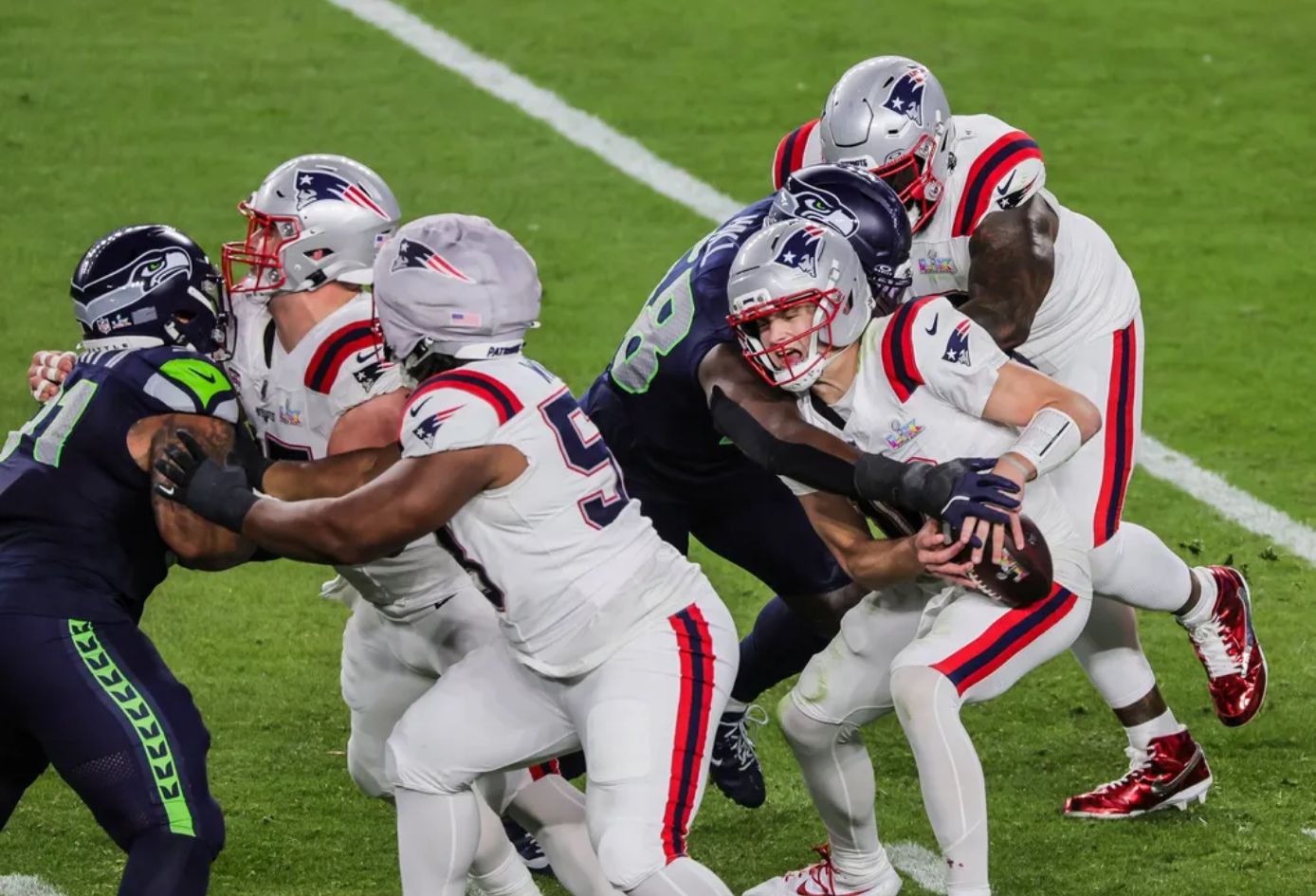
It’s too bad the defining image of Super Bowl 60 is eerily similar to last year’s game. In two years’ time, we’ve seen two superstar quarterbacks be neutralized by the league’s best defense, so much so that America’s most-watched sporting event turned into a one-way school fight, with bloodthirsty spectators all crowded around with their phones. If you haven’t caught on to the “defense wins championships” cliché by now, I don’t know what else to say to you.
Except, I actually do have a lot to say, so let’s break things down into my three big takeaways from the game and run down some defining numbers.
Takeaway #1: Seahawks’ “Dark Side” defense is one of the best in NFL history
It’s certainly no “Legion of Boom” by nickname standards, but the Seahawks’ defense deserves all the flowers as the dust settles on their remarkable 2025 season. They became the first unit to shut out an opponent through three quarters of a Super Bowl since the 1974 Steelers, another defense with a legendary nickname. They suffocated New England’s offense to their wits’ end. Forty percent of the Patriots’ plays went for zero or negative yardage, and they didn’t have a snap inside Seattle’s 43-yard line until two minutes into the fourth quarter. And when Drake Maye finally found a rhythm later in the fourth, the Seahawks answered with a second takeaway off one of Maye’s 10 off-target throws on the night, the most in a game in the young QB’s career.
The main reason why Maye, the runner-up for MVP, was so off in the Big Game was because he was constantly under siege by Seattle’s pass rush. The pressure got to Maye on 36% of his dropbacks — 19 times total according to ESPN Insights — with nine of those pressures coming from the left side of the offensive line — guarded by two rookies, left tackle Will Campbell and left guard Jared Wilson. New England became the first team to ever start multiple rookies on their offensive line in a Super Bowl, and the inexperience made for a broken dam against the waves of rushers faced from Seattle.
It wasn’t anything too complicated, either. Five of Seattle’s six sacks came on a four-man rush, and when they did bring extra bodies, New England had no answer, as Seattle got pressure on six of their seven blitzes. (Rejoice, Gen Alpha.)
The secret sauce to head coach and defensive play caller Mike Macdonald’s attack plan was using his best corner, Devon Witherspoon, as a blitzer. Witherspoon had only blitzed 33 times over 14 games before Sunday — and why up the antics, as it’s a rare occurrence for a team to consistently use their best cover corner in blitz schemes. But Witherspoon’s cat-like athleticism and physicality make him a force in that role, and Macdonald turned up the dial in the biggest game of the year, catching New England off guard.
Witherspoon blitzed six times to the tune of four pressures, three QB hits and a sack — and he should’ve been credited with another after lodging the ball from Maye’s hands into Uchenna Nwosu’s for a defensive score late in the fourth quarter. Witherspoon had a legit case for MVP in this game and just might have been the best player on the field.
There’s a reason NBC color commentator Chris Collinsworth crowned the Hawks defense in this game as “one of the most brilliant performances [he’s] ever seen in the National Football League,” after Derick Hall stripped the ball from Maye to end the third quarter up 12-0. Unlike some of Collinsworth’s takes, this is not hyperbolic. In fact, this dominant showing was not unlike Seattle’s first Super Bowl win in 2014, when they held the highest-scoring offense in NFL history to eight points in a 35-point stomping.
Having a dominant win in the Super Bowl is key to cementing a team’s legacy among the best to ever do it. In fact, the 2025 Seahawks rank as the third-best Super Bowl champion of all time, according to a take on ESPN’s DVOA metrics. Much of the credit goes to the defense and will continue to go to the defenses for many more Super Bowl champions to come.
Takeaway #2: Sam Darnold is a miracle worker
Darnold didn’t need to be remarkable in the Super Bowl, but his story sure had to be to get to this point.
Just two years ago, Darnold was a castaway backup quarterback on the 49ers and was barely thought to ever be a starter in the NFL again. He had carried the dreaded “draft bust” label from his disastrous three-year tenure with the Jets after being drafted third overall in 2018 as the franchise’s next supposed savior. His time in New York became defined by an infamous Monday Night Football game against the Patriots in 2019, where he admitted to “seeing ghosts,” and being ruled out indefinitely earlier that season with mononucleosis.
Turns out, much of Darnold’s downfall wasn’t his fault. He was failed by one of the most dysfunctional organizations in professional sports, and while he became a laughing stock in outside circles, he was doing the same things he’s doing today that made him a Super Bowl champion: working.
Darnold has never shown any resentment toward any of the teams or people who discarded him. He doesn’t have the proverbial chip on his shoulder. He’s had an unwavering confidence in himself and has grown accustomed to blocking out what others think.
According to ESPN’s Peter Scharger, Darnold’s longtime quarterback coach, Jordan Palmer, said Darnold used the same “muscle” to prepare for Super Bowl 60 that he’s used his entire career. Yeah, even when he was seeing ghosts.
Darnold said after the Super Bowl that people called him crazy for being so steadfast throughout his career. But he always knew he was capable of being a starting NFL quarterback. Part of what kept him grounded was his parents. He credits them for instilling the confidence in himself to “play free” and overcome all the obstacles that came his way — and eventually, find his way among the best signal callers in the game.
Now, Darnold is the first quarterback in NFL history to win a Super Bowl on his fifth team or later. He was still overcoming adversity as late as this season. He led the NFL with 20 turnovers in the regular season, and some still saw him as the sore spot ready to doom the Seahawks’ season. Instead, he became the first quarterback since Drew Brees in the 2009 playoffs to have no turnovers on the way to a Super Bowl title.
The offseason will give pundits plenty of time to debate where Darnold ranks among NFL quarterbacks now that he’s won more games than any QB in the last two seasons, with a ring to show for it. But one thing’s for certain: he’s a fighter — and the next obstacle he faces won’t be anything greater than the demons he’s already slayed.
Takeaway #3: The Patriots were young and outmatched, and they may never be back
All of the cute-story narratives about New England’s 2025 season came home to roost in the Super Bowl. The Pats played the third-easiest strength of schedule in the last 50 years, enroute to 14 wins and the two-seed in the AFC, and made the Super Bowl in large part because of horrific quarterback play from their postseason opponents, which masked their own offensive struggles in that same time. Even despite beating three of the league’s top five total defenses in the playoffs, the Seahawks were a cut above. In the wise words of Destiny’s Child… they weren’t ready for this jelly.
Still, despite their overachieving label, this was likely the best chance the Patriots’ core group of players had to win a Super Bowl together. It is incredibly difficult to reach the Big Game, and once a team does make it, the way they got there becomes irrelevant. It was time to cash in, but New England couldn’t do it.
Drake Maye finished just his second season as an NFL quarterback as the runner-up for league MVP and became the second-youngest QB to ever make the Super Bowl. He should have plenty of time to make it back, right? Look at the numbers: no quarterback who made the Super Bowl in their second season has ever returned. Not Joe Burrow, not Brock Purdy, not Colin Kaepernick, not Dan Marino. It’s a legendary feat, but it’s also unfortunate company to be in.
Add on the fact that the Patriots ran through the AFC in a year without Patrick Mahomes, Joe Burrow and Lamar Jackson in the playoffs — coupled with other superstar quarterbacks who look long overdue for postseason success — and the road ahead feels rather precarious for Mike Vrabel and company. As much as the Super Bowl is about being the best team in the biggest moments, it’s also a lot to do with luck, and the Patriots won’t have as big a share of it next season.
The favorable aspect of their success and precipitous swing from a four-win team two years ago to a 14-win team this year makes New England a prime candidate for regression in 2026. Sure, they still had the number-two scoring offense and third-highest point differential in the NFL, and those numbers are strong indicators for sustainment. But this is also one of the newest teams in football. Thirty players on the Patriots were in their first year with the team, the most ever for a team to make the Super Bowl. History suggested it would take time for those pieces to jell, but New England played well above their talent and experience level, and their performance in the Super Bowl suggests they may have overstayed their welcome.
Now comes the precipitous fall back to the bottom, and teams in this spot rarely recover quickly. The only team in the last 30 years that lost the Super Bowl and made it back the following year was the Tom Brady/Bill Belichick Patriots. That team was a dynasty, which transcended common fate.
The Patriots of today are not at that level. They need to accept that they overachieved and continue to aggressively add to their roster to keep pace with the rest of the AFC.
Halftime Show
Headliner: Bad Bunny
Guest Performers: Lady Gaga, Ricky Martin
Bad Bunny represented what it meant to be a true American on the world stage. In a show defined by cultural inclusion, a celebration of diversity and the power of togetherness, Bad Bunny proved why he was the perfect choice for the Super Bowl Halftime Show at this moment in time.
Now, I’m not here to pretend I understood many of the words that came out of his mouth. But I felt the message he was conveying, and I sincerely hope the ~128 million others who tuned in did, too.
The reason why the United States is the greatest country on Earth is because it learned to embrace people of all different cultures and backgrounds. Humans are inherently polarizing beings, and nothing is stronger than a place where everyone can come together and learn to live with one another. So when Bad Bunny started his performance in a sugar cane field — a nod to Puerto Rico’s colonial pedestal — and made his way through while giving more subtle nods to Caribbean culture, I thought, “This is what makes America great.”
Regardless of whether you like his music or not, you have to give it up to Bad Bunny for representing a broader cultural landscape on the world’s biggest stage — because that’s what the platform is for. The NFL wouldn’t make nearly as much money or absorb as much viewership as it does every year for the Super Bowl if its product wasn’t attractive to a global audience. And that’s a good thing. As the number one streamed artist in the world, Bad Bunny propelled the Super Bowl to what it’s supposed to be, while giving Caribbean culture a voice it never had before.
For the ones who weren’t familiar with his game, I hope you learned something new.
As for the show itself, who saw Lady Gaga making an appearance?? I never thought we’d see a pop star be involved in a showcase for Latin music, but Benito brought out all the stops. First a couple gets married during the show (and it was real), then Gaga comes out to serenade the crowd with a salsa rendition of “Die With a Smile.” That must have been a wonderful surprise to viewers who were used to hearing English singers.
Then, after what had to be the best dancing of the night to “NuevaYol,” Ricky Martin — one of the seminal Latin superstars — made an appropriate cameo to sing Bad Bunny’s song “Lo Que le Pasó a Hawaii” on a white plastic chair. Now the middle-aged-mom demographic had a score. But the act that soon followed had to be the best moment of the night.
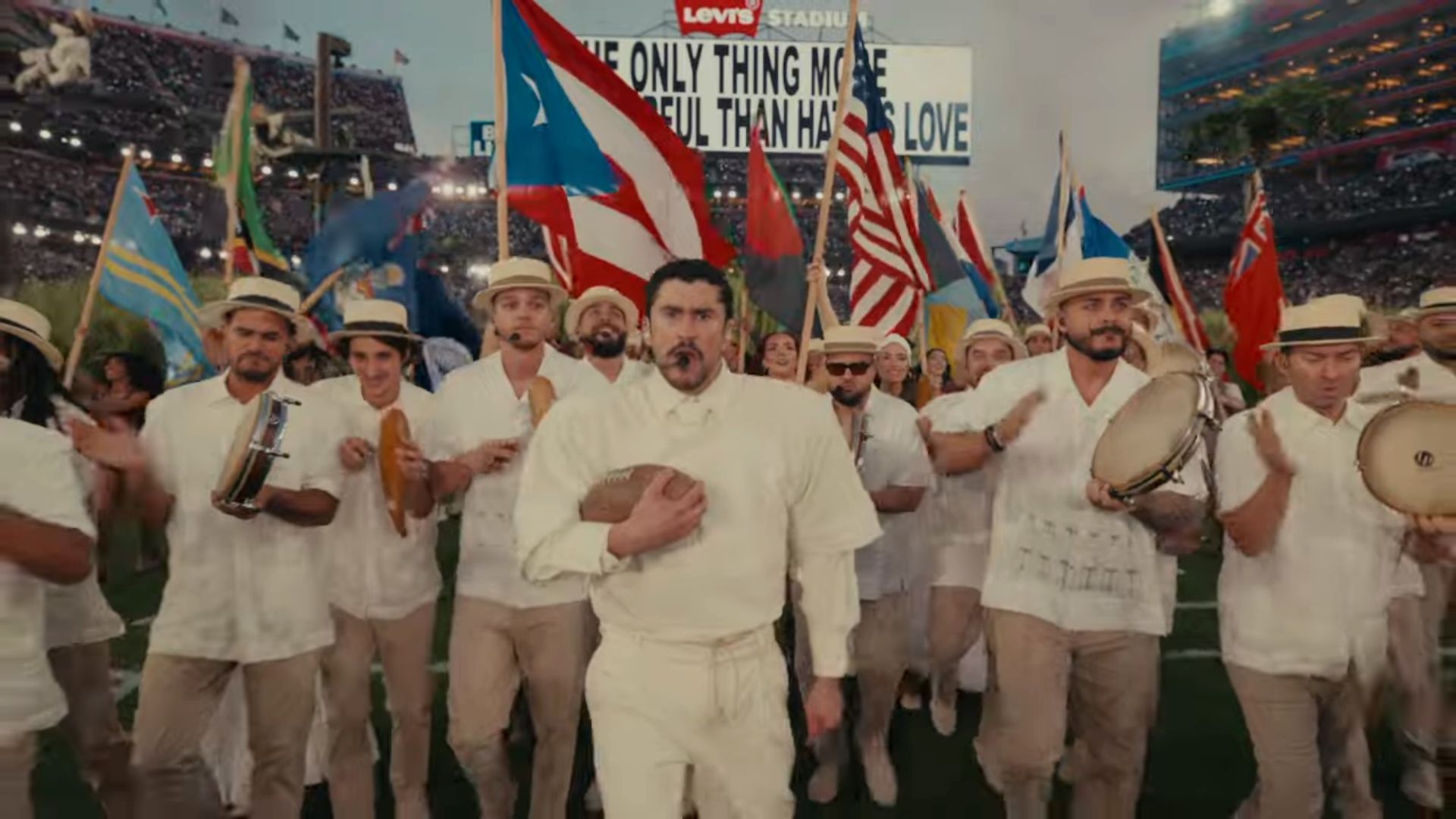
With a football in his hand, Bad Bunny delivered the most quintessential embrace of community the world stage had seen in years. He cried out, “God bless América,” and rattled off over 20 countries across North and South America as he locked eyes with the camera, with accompanying flags parading behind him. And to punctuate the message, the main takeaway was displayed on the big screen at Levi’s Stadium: “The only thing more powerful than hate is love.”
And for good measure, Bad Bunny spiked the football reading an additional message of unity — “Together, We Are America” — and sprung into a raucous celebration to close the performance.
With all of the nonsense that surrounded the lead-up to this show, Bad Bunny delivered on everything a fan could have asked for. He kept it about the music and the culture; he wasn’t too political; the production and set design were brilliant (who knew using humans as sugarcane plants could be so efficient?); he used the entire field to his advantage; and even though most viewers couldn’t understand what he was saying, the performance was uniquely intimate and felt like every voice was being heard.
The show felt as big as its message. It was the first real touchdown of the Super Bowl.
Grade: A+
Commercials
As a guy who begs for a good laugh while I’m deprived of football for 120-150 seconds at a time, the Super Bowl 60 commercial lineup was largely underwhelming.
According to an analysis by DAIVID — an AI-powered creative data platform — this year’s ads ranked as the most heartwarming in more than five years and the least funny since 2021. The ads also leaned more heavily on nostalgia than any Super Bowl this decade, with brands like Dunkin’ and Xfinity using de-aging technology and CGI to reimagine ‘90s pop culture, and T-Mobile, State Farm and Instacart spoofing retro music to get a kick out of their audience.
Not everything was geared toward moms and dads, though. You still knew it was 2026, because roughly a quarter of ads either sold or utilized artificial intelligence. That felt like a little much. I’ve never been a big AI guy, and no promotions of those products particularly tickled me. So, you won’t be finding the Alexa+ commercial in my rankings. (Can’t we humans just do things ourselves?)
Which brings me to my next beef with Super Bowl commercials…
My beef
Why have companies started releasing their Super Bowl ads before they get on the air??
What’s the fun in that? I’m sick of seeing all these clips on social media, and from the TODAY Show and other internet sites where all the ads are spoiled before they have their moment in the Super Bowl.
We’ve even started making teasers for ads. What?? It’s a commercial, not a movie. If your attention span is so fragile that you need to see a clip of a 30-second commercial before it airs, we really have gone too far with bit culture. If I already know what’s coming, why should I look forward to the commercial break? It destroys the point.
These ads are supposed to be a surprise. STOP RUINING THE FUN!!!
OK, where was I?
I guess it’s time to rank my top five commercials from this year’s pack. Again, nothing groundbreaking this year, but I did get a good kick out of a few.
These are snap judgements I made, and people go a thousand different directions on this. My rankings will likely be unlike any others you’ve seen already. And as you can tell, I favor humor over feel-good.
Let’s see how it shook out…
Top 5 Commercials
5. “Bananas” | Instacart
No way we were making it through the Super Bowl without a Benson Boone backflip. I personally got a bigger laugh out of Ben Stiller crashing out trying to imitate the flip than anything else on Super Bowl Sunday. This one was right up my alley. Now we know Instacart lets us choose our bananas’ ripeness. What fun.
4. “Stop Livin’ on a Prayer” | State Farm
This wasn’t State Farm’s best work — in fact, far from it after the King Henry ad this fall — but it was a loveable effort and pulled off an amusing depiction of your run-of-the-mill insurance company. What sold me was the casting. Keegan-Michael Key can make anything funny, especially a klutzy businessman, and Hailee Steinfeld raised all the right questions. “Filing a claim is tough” was a very good line. Makes me want to say it every time I hear the song now.
3. “Good Will Dunkin’” | Dunkin’
I’m surprised this ad wasn’t done years ago, but better late than never. You can count on three things in life: death, taxes and Ben Affleck will always do a Dunkin’ Donuts ad. This one combined actors from a number of ‘90s sitcoms, and they all meshed perfectly. A Boston-based sitcom with Dunkin’ as the hub would sell so many coffees. And did anyone else notice Affleck channeling his character from “The Accountant” in the opening shot?
2. “Hungry for the Truth” | Uber Eats
I’m on record saying this is one of my favorite ad campaigns of all time. I just can’t get enough of it, as seen in this ranking. The seemingly endless connections of football terms to food continue to amaze me. Likening the Pro Football Hall of Fame to a juicer was quite eccentric, and I should have been using a fork as a field goal post my whole life. The jokes just keep getting better.
1. “Relax Your Tight End” | Novartis
This commercial had the perfect blend of service promotion and humor, while also explaining the significance behind the called action. Everyone loves a good butt joke, so what better way to use it than by encouraging prostate cancer screenings? The serenity of a relaxed tight end (literally and figuratively) assured viewers that it’s not so bad. And casting Bruce Arians — a prostate cancer survivor who coached tight ends — as the main spokesman was a chef’s kiss.
Comment
Comments