
 Hannah Brooks
BY HANNAH BROOKS
Marketing Director
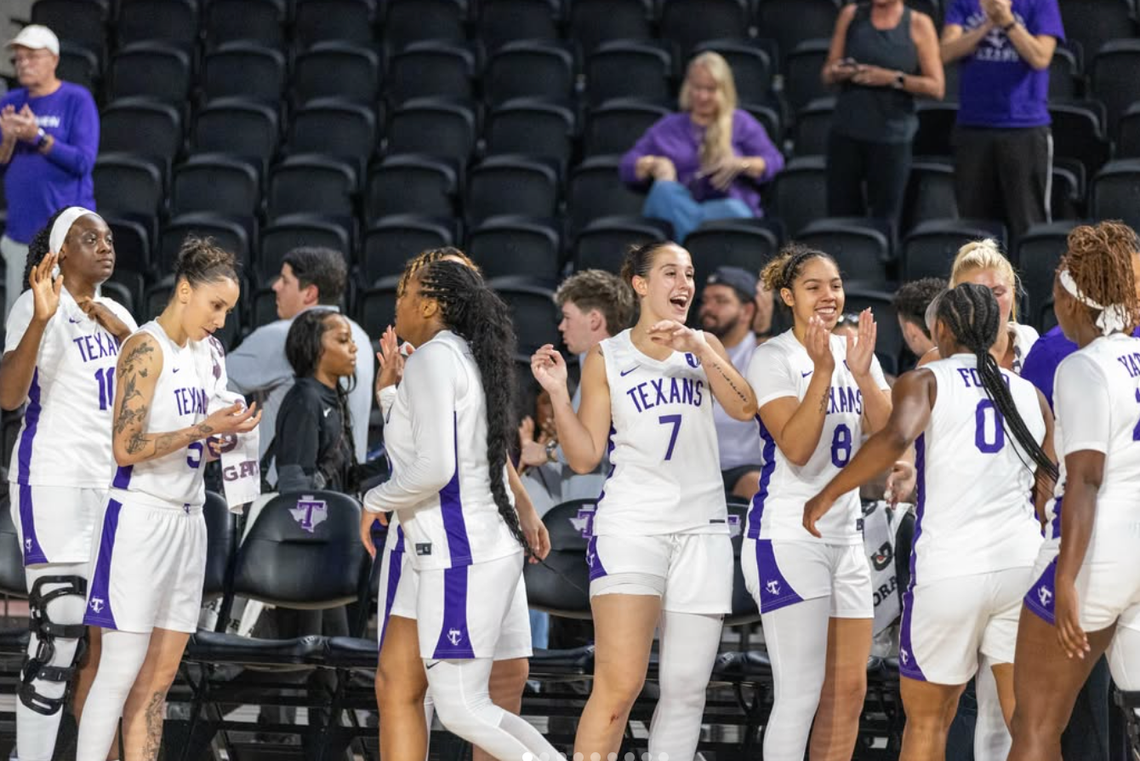
On Tarleton State University’s women's basketball team, the answer to "where are you from?" rarely stops at the Texas state line. Seven of the 14 players on the roster are international, with a diverse line-up from Brazil, France, Spain, Serbia and South Africa, according to associate head coach Geoff Golden.
The mix was not built around geography, Golden said. It came from a search for the best fit.
"We recruit players from everywhere," he said. "It's not necessarily that we're specifically looking for a player from Spain or Serbia or Dallas."
Golden said the staff builds the roster around what the team needs, not around a country. "It's more about what we need, position-wise, and the style of play that those players have," he said.
Sometimes the same type of player shows up on both sides of the Atlantic. Golden said a player he liked at an international event in the summer can look very similar to one he saw in Dallas, and the staff will recruit both.
In those cases, he said, international recruits can have an edge. A prospect from Dallas might not want to move to Stephenville, but "somebody from Serbia or Spain has no problem coming to Stephenville."
Golden travels overseas every year to scout international competitions. He does a lot of film work, he said, but much of the evaluation is hands-on. The FIBA U18 and U20 European championships bring together about 15 countries over roughly 10 days, which he called "a very efficient way to cover a lot of Europe in one event."
The events showcase what is "supposed to be the best of the best for that age group" from each country, he said. He agreed that many American coaches are scouting there too.
The Texas side of recruiting is just as thorough, he said. The staff subscribes to a scouting service based only in Texas and gets out to high school games throughout the season.
Summers are built around AAU events, he said. About 10 or 12 top programs in the state are where many of the best players compete, and the staff makes sure to see every one of those teams play.
"We cover Texas and local kids about as well as you can cover them," Golden said.
High school players are one pipeline among several, he said. The program also works with junior college players and the transfer portal, alongside international and local high school recruits.
"There is a transition period here," Golden said. Players coming from another country face differences both culturally and in how the game is played, he said, which starts with a coaching staff that understands that.
“I feel like we do a really good job internally here,” Golden said. “Sometimes players just need patience from us.”
The roster doesn't have to be half international, but, “having a high number of internationals, even just having three or four, makes assimilation easier.” Golden said.
Players can also turn to the university's international support office, which serves all international students on campus. If they want to step away from athletics, Golden said, it is a place to meet other international students and find support. "There's a lot here to help them," he said.
For the players, the adjustment looks different from person to person.
Lucia Navarro, an international student-athlete from Spain, grew up playing in Spain's club system, where she said she played for seven or eight years. “Spain has no school teams, so players come up through clubs.” she said.
She transferred to Tarleton from Oregon State after Golden reached out and invited her to visit.
"It was an amazing experience, so I decided to commit," she said.
The biggest surprise at first was the weather. Raining in Oregon, she said, made it hard to get motivated for practice or class. "Oregon was always cold, it was always raining," Navarro said.
On the court, each program she has played for has used a different system. She is playing the four and five at Tarleton. Off the court, she said, the work is staying focused in class.
She said the team's chemistry was immediate, and that the mix of backgrounds is part of what makes it work. "It's really special to have people from different countries because you can always learn from them," Navarro said.
Lesline Salim Penge, who was born and raised in South Africa to parents from Congo, played at a junior college in Arizona for two years before arriving at Tarleton.
Basketball is not widely played in South Africa, she said, where netball, rugby and cricket are more popular. Moving to the United States meant learning a different style and pace of the game, and she said the physical adjustment was painful at first.
The hardest part has been distance from her parents. She talks with them almost every day, she said, but still gets emotional after games when she sees teammates' families waiting for them. Penge said she reminds herself why she is here: to make her parents proud. She plans to return to South Africa when she finishes school in the U.S.
She also found a sense of belonging in the team's culture. “I like the fact that once we are done with every practice, the team will pray together. I'm Christian, but I was super shocked to see that at first. I thought, hm, this is nice.” Penge said.
She also hears French from some of her teammates. Her parents speak it, she said, so she understands it. When teammates talk to her in French, she answers in English, making it even easier to connect with each other.
Jovana Spasovski, originally from Serbia and a transfer from the University of Wisconsin, said she chose to play in the U.S. because of a choice European athletes often face. In Serbia, a basketball-crazy country, she said, athletes usually have to pick between pro sports and a degree. "It's either or," she said.
She said the European players on the team bring similar fundamentals, especially attention to detail and knowledge of the game.
Her agent heard from Tarleton's coaches, and she visited in April. “What I looked for is a coaching staff that would support me and believed in me.” Spasovski said.
After two Wisconsin winters, she said, the biggest relief was the warmer weather, and the people. “Everybody that I’ve met here has been very friendly and easy to talk to and a lot have some kind of sports interest.”
Spasovski dealt with a lot of homesickness her first year, she said. The seven-hour time difference means her friends and family are often asleep when she gets out of practice. “I'm going to go home for December break for a week. I miss my family every day and I miss the food. I really miss the food.”
Some American things still surprise her. "Everything in America is huge, for no reason," she said, pointing to the size of trucks and drinks.
On a team with several freshmen, she wants to be the teammate she once needed. "I was a freshman once, and one of them asked me about some of the same thoughts that went through my head when I was a freshman.” Spasovski said.
Months later, she has no doubts about the decision. “I think I made the best choice ever,” she said.
Comment
Comments